Detecting Missing Parts After Assembly
Detects missing components after assembly by verifying each required part in its own region of the image, then signalling OK/NG to the line.
Solution Overview
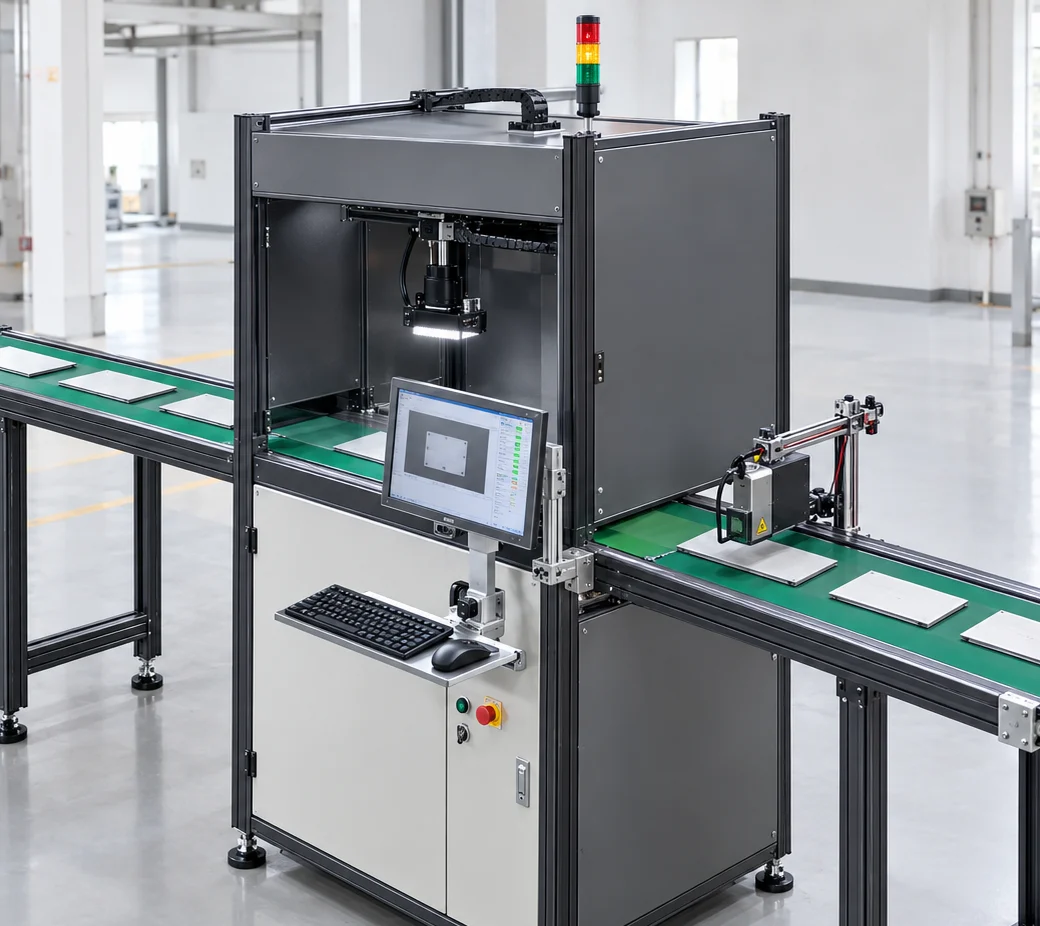
Assembly missing part visual inspection: for multi-step assembly scenarios, it verifies step by step whether each assembly element has been performed, promptly detecting missing parts, skipped process steps, and incomplete assembly, and outputs OK/NG while interlocking with the production line. The solution consists of three parts: imaging, algorithm, and interlocking; the judgement threshold must be biased according to the asymmetric cost of escapes and false rejections, and is subject to the results of a measured sample trial.
The difference between a missed operation and a missing part is this: A missing part is when the part has not arrived; a missing assembly is when the operation has not been performed. A product may have all its parts in place yet still be missing a process step that must actually be performed, such as press-fitting, dispensing, labeling or screw fastening.
Missing-part inspection therefore has to keep an eye on the resulting features after the process step is performed: the indentation or height that should be present after press-fitting, the position and count of screws after screw tightening, and the presence and routing of the adhesive bead after dispensing. Only by converting these result features into judgement-ready visual features can the equipment hold the process step on a person's behalf.
inspection Content
Items to verify on site for "assembly missing part visual inspection", listed by common case
Missing Part in the Press-Fit Process Step
- Bearing Press-Fitting
- Bushing Press-Fitting
- Dowel Pin Press-Fitting
- Seal press-fitting
Missing Part in the Screw-Fastening Process Step
- Insufficient Screw Count
- Screw Not Fully Tightened
- Missed Fastening Station
- Abnormal Screw-Fastening Sequence
Missing Part in the Coating Process Step
- Missing Dispensing
- Missing Grease Application
- Missing Coating
- Missing Solder Joint
Missing Part in the Mounting Process Step
- Missing Label
- Missing Foam Pad
- Missing insulating sheet
- Protective film not removed
Abnormal Assembly Sequence
- Skipped process step
- Process Step Sequence Reversed
- Semi-finished product transfer
- Unloaded Before Completion
Incomplete Assembly Elements
- Clip not engaged
- Connector not fully seated
- Wire harness not secured
- Retaining ring not installed
inspection Method
From trigger and acquisition to result output, how the judgement is produced
- 01 Workpiece-in-Place Trigger
- 02 image acquisition
- 03 Coordinate system alignment
- 04 Region verification at each process step
- 05 Result Feature Comparison
- 06 Composite Assembly Judgement
- 07 Output OK / NG
- 08 PLC interlocking
- 09 Release / Quarantine
In multi-step scenarios, the inspection sequence follows Physical Assembly Sequence. Listing them is the most straightforward and makes problems easiest to locate: if a process step's acceptance criteria are not met, the shop floor knows which station to return the part to.
Note that the same position may have several reasonable visual manifestations. For example, correct press-fit seating may appear as a consistent height, or as correctly positioned indentations. The acceptance criteria should be chosen the most stable one, least affected by illumination and batch variation, rather than the one that looks the most precise.
judgement and Interlocking
How results are judged and passed to the production line
| Inspection Status | judgement | Interlocking Action |
|---|---|---|
| All process step elements present | OK | Release to the next process step |
| A process step element is missing | NG | Isolate to a rework station and complete the process step |
| Element present but state uncertain | re-inspection | Re-capture or manual confirmation before release |
The value of missing-part inspection lies not only in "picking out defective parts", but also in Exposes Process Step Problems: If missing parts occur repeatedly at a given process step, the problem may lie in upstream equipment or material supply; the inspection data itself is a troubleshooting clue.
When interlocking with the PLC, it is recommended to distinguish two signals, "single defect" and "consecutive defects": the former only requires rejection, while the latter should trigger a line stop or an alarm to prevent continued output of the same problem.
Related Inspection Objects
View more specific object characteristics, acceptance criteria and optical notes by object
Applicable Industry
Scenarios in These Industries That Already Have Corresponding Inspection Needs
Common Question
Questions most often asked during selection and implementation
What Is the Difference Between a Missing Assembly and a Wrong Part?
A missing part is "what should have been done was not done" (the part is not in place, the process step was not performed); a wrong part is "it was done, but done wrong" (reversed part, wrong model, wrong orientation). The first checks existence, while the second also has to judge attribute and orientation, which makes the acceptance criteria design more complex.
Can missing-part inspection replace 100% manual inspection?
At process steps where the acceptance criteria are clear and imaging is stable, visual inspection can take on 100% inspection and is more consistent than manual labour. However, for process steps whose criteria are hard to quantify or that require tactile or auditory judgement, it is still recommended to keep manual labour or switch to other sensing methods — there is no need to force vision to solve every problem.
Should multiple process steps share one camera, or should each step have its own?
It depends on whether the process steps are completed at the same position and at the same moment. For several process steps completed in sequence at the same station, one camera can image them at different times; process steps distributed across different stations need their own acquisition points. The core constraint is Whether the result features can be captured after each process step is completed.
What If Product Models Change Frequently?
Make "model" a dimension of the inspection solution (recipe): when the model changes, switch to the corresponding inspection regions and acceptance criteria templates. The switch can be done automatically by a model signal from the PLC, or selected by the operator in the interface.
How are the acceptance criteria for this solution defined?
The value of missing-part inspection lies not only in "sorting out defective parts" but also in exposing process problems: if missing parts occur repeatedly at a certain process step, the problem may lie in upstream equipment or material supply, and the inspection data itself is a troubleshooting clue. When interlocking with the PLC, we recommend distinguishing two signals, "single defective part" and "consecutive defective parts": the former only needs rejection, while the latter should trigger a line stop or alarm to prevent the same problem from continuing to produce output.
What is the inspection method?
In multi-process scenarios, arranging the inspection sequence in physical assembly order is the most intuitive and makes problems easiest to locate: if the criteria for a process step are not met, the site immediately knows which station to return to. Note that the same position may have several legitimate visual manifestations. For example, press-fit seating may show up as consistent height, or as a correctly positioned press mark. The criterion should be the one that is most stable and least affected by illumination and batch variation, not the one that looks the most precise.
Which Inspection Objects Is This Solution Applicable To?
View the object characteristics, acceptance criteria and optical considerations for each object; it covers 8 common object types including screw presence/absence inspection, spring presence/absence inspection, clip presence/absence inspection and seal ring presence/absence inspection.
Can this solution replace manual labor?
What visual inspection replaces is repetitive visual judgement, not manual labor for everything. The typical division of labor is: vision performs part-by-part full inspection and judgement, while people handle re-judgement of borderline samples, changeovers and exceptions, and maintenance of the optics and tooling. How many people are actually involved depends on the degree of automation and the re-judgement strategy.
How do you verify that this solution is feasible?
Please provide the assembly flow chart (process sequence) and photos of the results at each process step; our engineers will judge process step by process step which elements are suitable for vision verification.
Submit sample testing
Please provide the assembly flow chart (process sequence) and photos of the results at each process step; our engineers will judge process step by process step which elements are suitable for vision verification.
Submitted successfully
We have received your sample testing request. A solution engineer will contact you within 1 business day via contact you.
Need to assess imaging conditions, defect criteria and cycle time item by item? Go to the Full Requirement Assessment →
Submit Samples to Get a Visual Inspection Solution
Tell us the workpiece, inspection requirements, production line cycle time and your existing PLC / communication method, and our solution engineers will recommend the inspection method, optical configuration and interlocking solution.