Woven Fabric AI Visual Inspection Equipment
Woven fabric AI visual inspection equipment targets warp and weft structured woven cloth, performing inline inspection of warp and weft breaks, missing weft, weft shrinkage, holes, weaving defects, oil stain, color differences and other defects, with OK/NG output and production line interlocking.
Materials Overview
Warp and weft structures are more stable than knit, but stripe and check matching needs extra handling
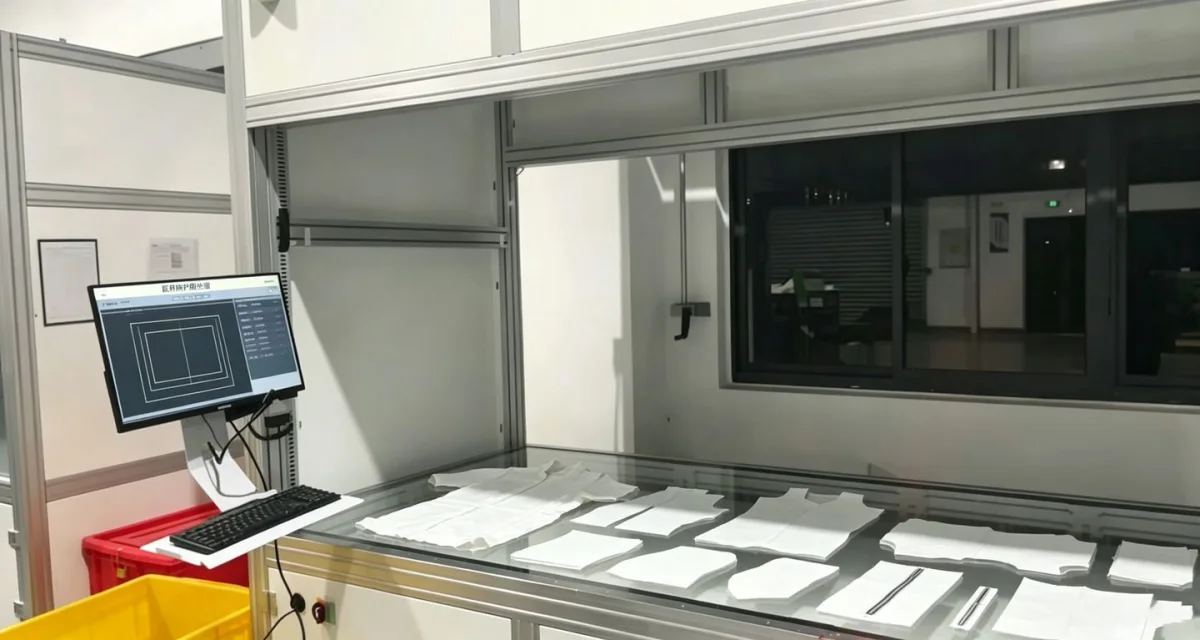
Woven fabric AI visual inspection equipment images warp-and-weft woven cloth, and the algorithm identifies defects such as broken warp, broken weft, missing weft, weft shrinkage, holes, weaving defects, oil stain, and color difference, outputs OK/NG results, and interlocks with the production line. It is suitable for roll and cut-piece formats.
Woven fabric is formed by warp and weft yarns interwoven at right angles; its structure is flatter and more stable than a knit, and it does not stretch easily, so positioning is relatively easy. However, its warp and weft directions are strongly oriented, and once a yarn breakage or weaving fault occurs the defect extends along the warp or weft, a directional characteristic that should be exploited during recognition.
Defects specific to woven fabric include broken warp, broken weft, missing weft, weft shrinkage (curled weft yarn), holes, weaving defects (missing warp or weft, float stitches, reed marks), oil stains, and color difference. Plaid and striped fabrics additionally require stripe and check matching inspection to prevent cutting offset.
Woven fabric is mostly used in garments, bags and luggage, automotive interiors, and home textiles, with a very large number of varieties. For inspection, AI distinguishes normal weave texture from weaving defects; for plaid fabrics, a datum is established and offsets are then compared against it. Changing varieties mainly means adjusting illumination and recipe.
Applicable Type
Plain Weave
Basic weave structure, with the focus on warp and weft breaks and holes
Twill / Satin
Structure variation, with a focus on weaving faults and gloss
Check / Stripe
Patterned; the focus is on stripe and check matching
High-density Woven Fabric
Fine, dense yarn; high pixel equivalent requirement
Woven Cut Pieces
Already cut, inspected piece by piece with defect locating
Common defect
| Defect Types | Typical Manifestations | Inspection Focus Points |
|---|---|---|
| Broken warp | Single or multiple warp yarn breaks | Elongated along the warp direction |
| Weft Break / Missing Weft | Missing Weft Yarn | Elongated along the weft direction |
| Weft shrinkage | Weft yarn curling, loop formation | Look for local bulges on the fabric surface |
| hole | Warp/weft breakage forming holes | Backlight Is the Most Direct |
| Weaving Defects | Missing warp, skipped yarn, reed mark | Requires a normal weave structure model |
| Oil Stain / Dirt | Oil Spots, Stains | Contrast Against Base Color |
| color difference | Inconsistent shade within the same batch | Stable light source and color datum |
| Stripe and check matching deviation | Plaid and stripe misalignment | Requires Datum Comparison |
inspection Workflow
Complete chain from loading to judgment
- 01 Woven fabric loading / roll unwinding or cut-piece feeding
- 02 Flattening and tension control
- 03 Triggered Imaging
- 04 Warp/weft direction positioning
- 05 Region segmentation and defect segmentation
- 06 Weaving defect classification and grading
- 07 Stripe and check matching comparison (plaid fabric)
- 08 Synthesized OK / NG
- 09 Marking / rejection and image archiving
AI Inspection Principles
AI Visual Inspection Principles
Woven fabric inspection exploits the warp-and-weft directionality: normal construction is a regular orthogonal grid, and defects break this periodicity. The algorithm builds a model of the normal construction and judges deviations such as missing warp, missing weft, weft shrinkage and weaving faults as anomalies; for plaid fabrics an additional baseline comparison is made. Imaging stability remains the precondition.
For illumination, diffuse light provides uniform lighting to see oil stain and color difference clearly, while low-angle light exposes surface relief and reed marks. Stains on dark woven fabric and holes in light woven fabric require separate light settings, with recipes grouped by color.
Stripe and check matching requires establishing a datum pattern on an OK sample first, then comparing the actual offset. The specific tolerance is subject to the customer's acceptance criteria and must be confirmed by measured sample testing.
Applicable Industry
Applicable equipment
Common Question
Where does the inspection difficulty differ between woven and knit fabrics?
Can stripe and check matching on plaid fabric be checked?
Can weave defects be seen clearly in high-density fine-yarn woven fabric?
Can Back-Side Defects Be Detected?
What is the inspection accuracy?
What samples are needed to develop a solution?
Can It Be Integrated Into an Existing Production Line?
Submit sample testing
Send us OK and NG samples of woven fabric in different weaves and colors (including plaid samples), and we will carry out weave modeling and measured stripe and check matching to recommend an illumination solution.
Submitted successfully
We have received your sample testing request. A solution engineer will contact you within 1 business day via contact you.
Need to assess imaging conditions, defect criteria and cycle time item by item? Go to the Full Requirement Assessment →
Send Us Your Material and We Will Show You the Measured Results
Provide several OK and NG samples of the material, and a solution engineer will run actual imaging and judgement tests on the equipment to give a workable inspection configuration recommendation, rather than reading the datasheet alone.