New Energy Vehicles
For new energy vehicle three-electric systems and complete vehicle assembly, providing inspection solutions for component presence/absence, correct assembly seating, wrong part and sealing.
Industry Production characteristics
How This Industry Produces Determines How Inspection Should Be Done
The visual inspection of new energy vehicles revolves around two things: first, making the most common defects in this industry image clearly and consistently; second, connecting the judgement result reliably into the production line. Common implementation constraints in this industry are "insulating parts are mostly dark plastics, giving low contrast against dark workpieces"; "connectors are located deep inside, limiting the viewing angle". Whether detection can be stable depends on material optical properties, minimum defect size, and cycle time, and is subject to the results of a measured sample trial.
The assembly characteristics of new energy vehicles are Many high-voltage safety-related steps and strong constraints on assembly sequence: a single missing seal can cause the protection of an entire package to fail, and one wrongly installed connector can cause contact problems.
Visual inspection in this industry typically handles Release confirmation at key process steps — it does not replace all inspection, but guards the process steps where an escape can never be recovered.
Industry Inspection issues
Where problems actually occur on site
- High-voltage connector not fully mated
- Missing seals and insulation parts
- Bolt tightening count and sequence must be confirmed
- Busbar / wire harness assembly error
- Labels and traceability codes must match the work order
Typical Inspection Objects
The Most Common Inspection Objects in This Industry
Typical Inspection Task
The judgments to be made on these objects
- Confirm high-voltage connectors are fully seated
- Checking for missing seal and insulation parts
- Bolt count and position verification
- Busbar / harness routing and position check
- Traceability code reading and content verification
Vision Inspection Challenges
Implementation constraints specific to this industry
- Insulating parts are mostly dark plastic, with low contrast against dark workpieces
- Deep connector positions limit the viewing angle
- Large workpieces such as battery packs require multi-view coverage
- Safety parts cannot be reworked; judgement must be reliable
Choosing the right algorithm
Choose by Acceptance Criteria Form, Not by How Advanced It Is
Rule-Based Algorithms Predominate
For items with clear acceptance criteria such as presence/absence, seating and count, use rule-based algorithms first
Classification
Distinguish connector models and specifications
Code Reading / OCR
Read traceability information and verify
acquisition and light source
Optical conditions set the upper limit of feasibility
- For dark insulating parts, grazing light is recommended so that edges cast shadows and separability improves
- For large workpieces, use multiple cameras for zone coverage to avoid insufficient resolution caused by an overly large single-camera field of view
- When there are metal structures around high-pressure parts, watch for the effect of occlusion and reflection on imaging
OK / NG Judgement
How results are judged and used
| Inspection Status | judgement | Interlocking Action |
|---|---|---|
| All key assembly elements in place | OK | Release to the next process step |
| Missing part / not fully seated | NG | Isolate in place and block flow to subsequent process steps |
| Inconclusive Judgement | re-inspection | Escalate to manual confirmation to avoid false release |
PLC and Automation Interlocking
How results connect to the production line
For safety-related process steps, it is recommended to use "Release only after inspection passes" interlocking approach rather than "reject after a defect is detected", to prevent workpieces from escaping unexpectedly in abnormal states.
We recommend binding inspection results to the battery pack / vehicle ID to support later traceability queries.
Applicable equipment
Common configuration forms for this type of inspection
Related Solutions
View the corresponding solution by inspection task
Common Question
The Questions Most Often Asked in This Industry
How Are Dark Insulating Parts and Black Workpieces Inspected?
Creating edge contrast through illumination is the main approach: grazing light casts a shadow at the edge of the insulating part, or light of different wavelengths enhances the material difference. Such combinations must be validated by actual imaging, not judged from specifications.
The Battery Pack Is So Large; How Is It Covered?
Multi-camera zone coverage is usually used, with each camera responsible for one area, and the results are finally combined into a complete package result. The number of cameras depends on the number of points to be verified and the imaging resolution required at each point.
For visual inspection in this industry, what needs to be solved first?
The implementation constraints commonly seen in this industry center on: "insulating parts are mostly dark plastic, giving low contrast with dark workpieces"; "connectors sit deep, so the viewing angle is limited"; "large workpieces (such as battery packs) need multi-view coverage". These constraints affect both the imaging solution and the cycle-time design. Normally a sample trial is needed to validate before the configuration is finalized.
How does the inspection result interlock with the production line?
For safety-related process steps, we recommend a "release only on inspection pass" interlock rather than "reject after a defect is detected", so that workpieces do not escape unexpectedly in an abnormal state. We recommend binding inspection results to the battery pack / vehicle ID to support later traceability queries.
What Equipment Configuration Does This Type of Inspection Generally Require?
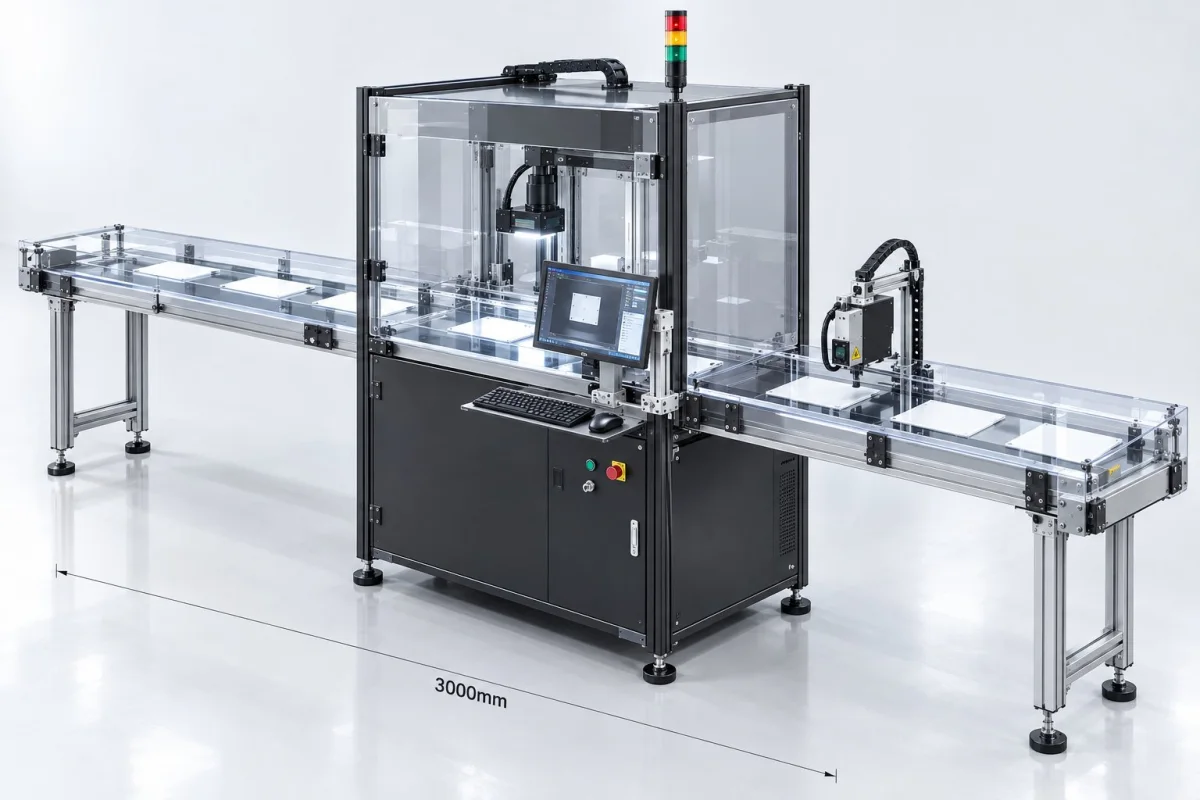
Common forms include: "EEK-SV5205C industrial vision presence/absence inspection equipment", "multi-camera distributed inspection station", and "data return interface that works with the existing MES". The specific machine model and quantity depend on the inspection area, minimum defect size, and line cycle time, and must be confirmed against the site conditions.
Which process steps in this industry benefit most from a visual inspection station?
The most common are: "high-voltage connector mating confirmation"; "screening for missing seals and insulating parts"; "bolt count and position verification". Which process steps to actually instrument depends on the cost of defects escaping downstream and the cost of rework — the later a defect is found, the higher the cost.
How do we judge whether our product is suitable for visual inspection?
Please provide assembly photos of the critical process steps and a list of the parts that should be fitted, and state which steps are "irreversible once they pass downstream". In general, as long as the acceptance criteria can be stated clearly, the defects can image clearly and consistently, and the cycle time matches the field of view, the project's feasibility is confirmed.
What inspection accuracy can be achieved?
Accuracy is not a fixed value that holds regardless of conditions. To be added — the minimum detectable size depends on the combination of field of view and camera resolution, and is also affected by illumination, lens and algorithm; the configuration must be derived from your minimum defect size and validated by measurement.
Submit sample testing
Please provide assembly photos of the critical process steps and a list of the parts that should be installed, and indicate which process steps are irreversible once they flow out.
Submitted successfully
We have received your sample testing request. A solution engineer will contact you within 1 business day via contact you.
Need to assess imaging conditions, defect criteria and cycle time item by item? Go to the Full Requirement Assessment →
Inspection Configuration Based on Your Industry's Products and Cycle Time
Send us photos of the workpiece, the inspection requirement (what to inspect, and the tolerance for escapes and false calls), and the line cycle time, and our solution engineers will recommend the inspection method, optical solution, and interlocking configuration for that industry.