Product Count Inspection
Automatic counting and count verification for products, parts or items inside packaging, applicable to cartoning, trays, material boxes, carrier tape and similar scenarios.
inspection Overview
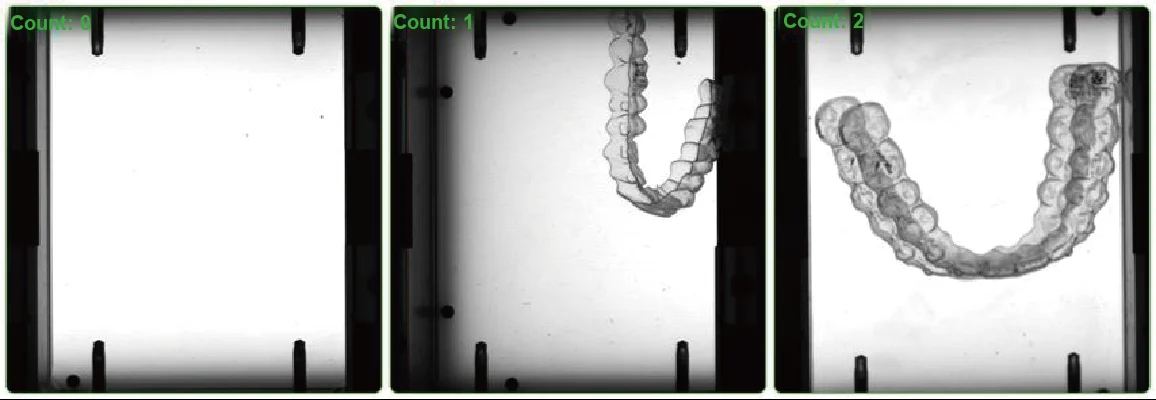
Product count inspection: automatic counting and count verification of products, parts, or items in packaging, suitable for cartoning, pallets, material boxes, and tape-and-reel applications. Judgement usually does not assess details such as threads or dimensions, but rather Whether the visual feature at that position exists and matches expectations, output OK / NG and interlock with the production line.
Automatically counts and verifies the quantity of products, parts or items inside packaging, suitable for cartoning, pallets, material boxes and tape reels.
The feasibility of "product count inspection" depends on Whether the visual features of the object are stable and distinguishable, as well as the on-site optical and tooling conditions. Each item is expanded below in the order commonly used in inspection engineering.
Object Characteristics
How the object appears in the image
- Items to be counted may be closely packed or overlapping
- Counts may range from a few to several hundred
- Various packaging forms: bag, box, tray, carrier tape
- When the objects are small, the total count places high demands on imaging resolution
inspection Challenges
Where Problems Really Occur on Site
- Overlap breaks the premise of "one target, one count"
- Boundaries disappear when reflective parts merge together
- When counting across multiple regions, avoid double-counting between regions
- Motion blur on high-speed production lines affects segmentation
Vision Judgement method
How acceptance criteria are set and why
The core idea is: First make the targets separable, then count them one by one: illumination or tooling creates a separable boundary between adjacent targets, then segmentation or projection counting is used.
If the targets themselves cannot be separated (severe overlap), the strategy should be changed: switch to a presence judgement of "enough or not enough", or add physical separation steps such as tipping / shaking.
Applicable algorithm
Choose by the Form of the Acceptance Criteria, Not by Complexity
Target Segmentation + Counting
Standard approach for separable targets
Projection / Region Statistics
Projection counting is more stable for regularly arranged items
Optical Precautions
Imaging conditions set the upper limit of feasibility
- Backlighting gives the clearest contour for opaque parts and is the first choice for counting applications
- For reflective parts, use diffuse light or polarization so that highlights do not merge adjacent parts together
- In tape / carrier tape scenarios, backlight through empty positions can reveal missing parts
OK / NG Output
How results are judged and passed to the production line
| Inspection Status | judgement | Interlocking Action |
|---|---|---|
| Count equals the expected value | OK | release |
| Count below the expected value | NG | Handle as missing part to be replenished |
| Count above the expected value | NG | Treat as extra part |
Applicable Industry
This type of inspection is common in the following industries
Common Question
The most common questions about this object
Can overlapping parts be counted accurately?
This is very difficult with severe overlap. The feasible path is to solve physical separation first (vibratory bowl, tipping, tooling stops), or to fall back to judging only whether the count is sufficient. We do not recommend promising an exact count directly in scenarios with severe overlap.
How Fast Can It Count?
It depends on the exposure time and the cycle time requirement. The higher the speed, the shorter the exposure available, and the greater the demand on lighting brightness and stability. The speed actually achievable should be determined by on-site measurement.
What are the acceptance criteria for this object?
The core is to make the targets separable first, then count them one by one: use illumination or tooling to create separable boundaries between adjacent targets, then count by segmentation or projection.
What are the illumination requirements for this type of object?
Backlighting makes the contour of opaque parts clearest and is the preferred choice for counting applications. For reflective parts, diffused light or polarization is recommended to prevent adjacent parts from merging because of specular highlights.
What Are the Inspection Accuracy and Minimum Detectable Size?
It depends on the combination of field of view and camera resolution, and is affected by the lens, illumination and algorithm. To be added — the configuration must be derived from your minimum defect size, subject to the results of a measured sample trial.
How Do We Verify That Our Product Can Be Detected?
Please provide the parts to be counted (including the most densely packed / most overlapped state) and the packaging or tooling format, and describe the counting rules.
Submit sample testing
Please provide the parts to be counted (including the most densely packed / most overlapped state) and the packaging or tooling format, and describe the counting rules.
Submitted successfully
We have received your sample testing request. A solution engineer will contact you within 1 business day via contact you.
Need to assess imaging conditions, defect criteria and cycle time item by item? Go to the Full Requirement Assessment →
Send Us Your Workpiece and We Will Show You the Measured Results
Provide several OK and NG samples, and the solution engineer will run actual imaging and judgement tests on the equipment, then give inspection configuration recommendations that can be implemented, rather than just reading a specification table.