Lithium Batteries
For the electrode sheet, winding / stacking, assembly and appearance stages of lithium battery manufacturing, providing inspection solutions for presence/absence, position, appearance anomalies and markings.
Industry Production characteristics
How This Industry Produces Determines How Inspection Should Be Done
The visual inspection of lithium batteries revolves around two things: first, making the most common defects in this industry image clearly and consistently; second, connecting the judgement result reliably into the production line. Common implementation constraints in this industry are "roll materials move at high speed, and motion blur affects clarity"; "metal foil reflects strongly, making surface features hard to reveal". Whether detection can be stable depends on material optical properties, minimum defect size, and cycle time, and is subject to the results of a measured sample trial.
Lithium battery manufacturing is characterized by Long process chain, high cleanliness requirements, and extreme sensitivity to foreign matter and appearance defects. Even a tiny metal foreign particle or electrode sheet burr can develop into a safety problem in later use.
Visual inspection in this industry often requires High-speed winding or transfer conditions, which places higher demands on exposure time, light source brightness and processing speed.
Industry Inspection issues
Where problems actually occur on site
- Electrode sheet coating edge anomalies, material loss
- Tab position offset or missing
- Weld presence/absence and weld spot condition
- Missing insulation sheets, blue film, and other auxiliary parts
- Surface foreign matter, scratches, wrinkles
Typical Inspection Objects
The Most Common Inspection Objects in This Industry
Typical Inspection Task
The judgments to be made on these objects
- Tab presence/absence and position verification
- Insulator and blue film missing-part screening
- Weld presence/absence judgement
- Appearance anomaly recognition (scratch, wrinkle, foreign matter)
- Barcode / QR code reading and traceability
Vision Inspection Challenges
Implementation constraints specific to this industry
- Web material moves at high speed, and motion blur affects sharpness
- Metal foil is highly reflective, so surface features are not easily revealed
- Foreign matter and defects are extremely small, placing high demands on resolution
- Cleanrooms impose requirements on equipment materials and particle emission
Choosing the right algorithm
Choose by Acceptance Criteria Form, Not by How Advanced It Is
High-Speed Acquisition + Rule-Based Judgement
For moving parts, use a strobe light source and short exposure to freeze the image
Anomaly Detection
Appearance defects that are hard to enumerate are modeled using the normal state
code reading
Battery cell traceability code reading
acquisition and light source
Optical conditions set the upper limit of feasibility
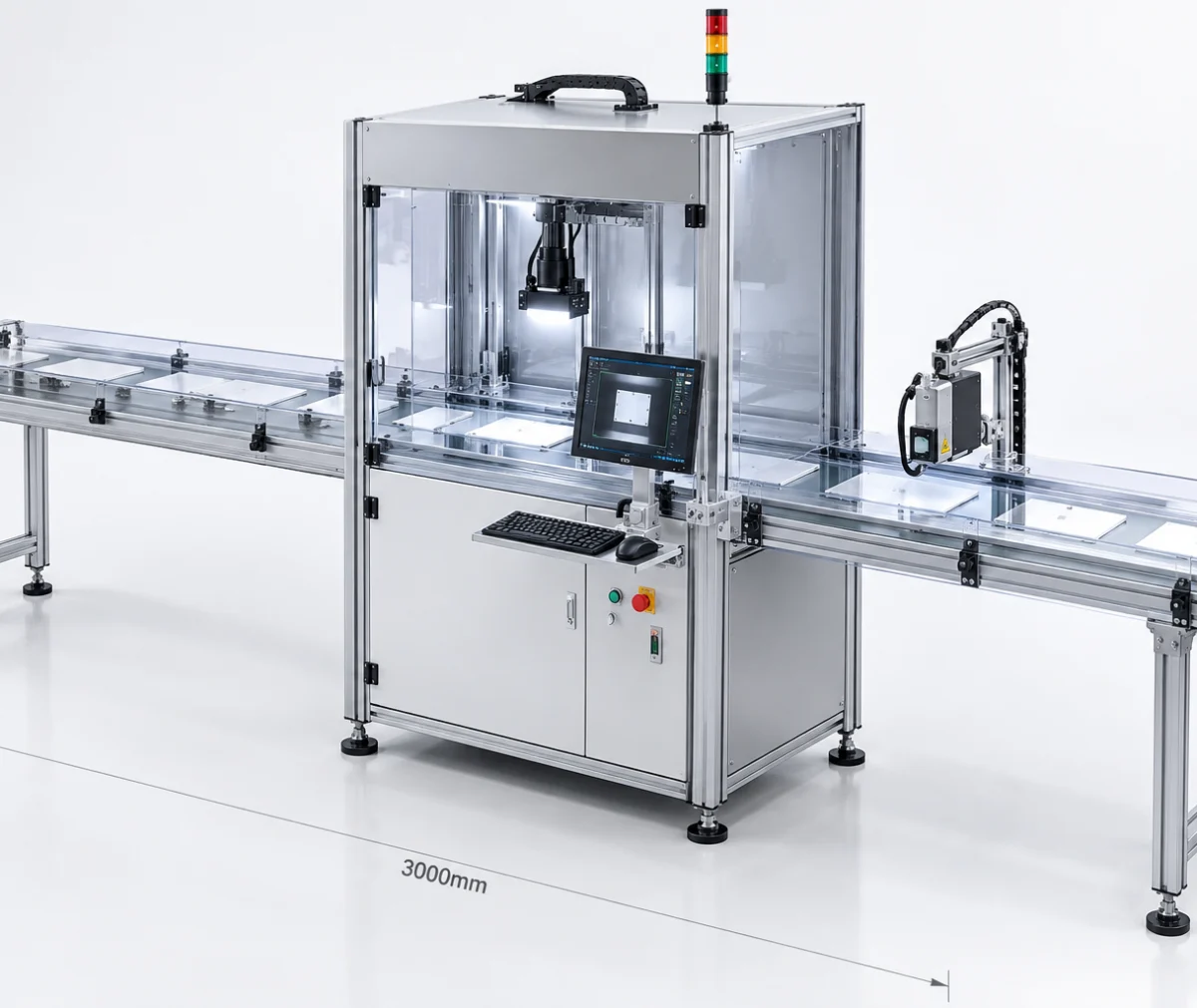
- A high-frequency strobe light source with short exposure is a standard combination in high-speed scenarios
- For metal foil, coaxial light or illumination at a specific angle is recommended to suppress specular reflection
- Detecting small defects requires high-resolution lenses and low-distortion imaging
OK / NG Judgement
How results are judged and used
| Inspection Status | judgement | Interlocking Action |
|---|---|---|
| All verification items pass | OK | release |
| Missing part, offset or anomaly present | NG | Reject and record defect images |
| Consecutive anomalies | Alarm | Prompt upstream process step check |
PLC and Automation Interlocking
How results connect to the production line
We recommend binding the inspection result to the battery cell / roll number and sending it back, for quality traceability and process improvement.
On high-speed production lines, the rejection action must be precisely synchronized with workpiece position; the accuracy of trigger timing directly affects the rejection success rate.
Applicable equipment
Common configuration forms for this type of inspection
Related Solutions
View the corresponding solution by inspection task
Common Question
The Questions Most Often Asked in This Industry
Can high-speed winding be inspected?
Yes, but a strobe light source with short exposure is needed to capture moving workpieces sharply. The speed actually usable depends on how exposure time, light source brightness, and workpiece motion speed match one another, and must be validated on the actual machine.
Can tiny foreign matter on electrode sheets be detected?
The smallest detectable size is determined jointly by the imaging resolution and the contrast between the foreign matter and the background. Detection capability must be validated with foreign matter samples of known size, not extrapolated from specifications.
For visual inspection in this industry, what needs to be solved first?
The implementation constraints commonly seen in this industry center on: "roll material moves at high speed, and motion blur affects clarity"; "metal foil is strongly reflective, so surface features are hard to reveal"; "foreign matter and defects are extremely small, which demands high resolution". These constraints affect both the imaging solution and the cycle-time design. Normally a sample trial is needed to validate before the configuration is finalized.
How does the inspection result interlock with the production line?
It is recommended to bind inspection results to the battery cell / roll number and send them back, to make quality traceability and process improvement easier. On high-speed production lines, the rejection action must be precisely synchronized with the workpiece position, and the accuracy of the trigger timing directly affects the success rate of rejection.
What Equipment Configuration Does This Type of Inspection Generally Require?
Common forms include: "EEK-SV5205C industrial vision presence/absence inspection equipment", "high-speed inline inspection station (with strobe light source)", and "multi-camera zoned inspection system". The specific machine model and quantity depend on the inspection area, minimum defect size, and line cycle time, and must be confirmed against the site conditions.
Which process steps in this industry benefit most from a visual inspection station?
The most common is: "verification of tab presence/absence and position"; "screening for missing insulation parts and blue film"; "judging whether welding is present". Which process steps to actually instrument depends on the cost of defects escaping downstream and the cost of rework — the later a defect is found, the higher the cost.
How do we judge whether our product is suitable for visual inspection?
Please provide electrode sheet / battery cell samples to be inspected and samples with known defects, and state the line speed and cleanliness requirements. In general, as long as the acceptance criteria can be stated clearly, defects image clearly and consistently, and the cycle time matches the field of view, the project is feasible.
What inspection accuracy can be achieved?
Accuracy is not a fixed value that holds regardless of conditions. To be added — the minimum detectable size depends on the combination of field of view and camera resolution, and is also affected by illumination, lens and algorithm; the configuration must be derived from your minimum defect size and validated by measurement.
Submit sample testing
Please provide the electrode sheet / battery cell samples to be inspected and known defect samples, and state the production line speed and cleanliness requirements.
Submitted successfully
We have received your sample testing request. A solution engineer will contact you within 1 business day via contact you.
Need to assess imaging conditions, defect criteria and cycle time item by item? Go to the Full Requirement Assessment →
Inspection Configuration Based on Your Industry's Products and Cycle Time
Send us photos of the workpiece, the inspection requirement (what to inspect, and the tolerance for escapes and false calls), and the line cycle time, and our solution engineers will recommend the inspection method, optical solution, and interlocking configuration for that industry.