OCR Inspection of Model, Serial and Date Codes
Reads and verifies printed characters - model, serial number, batch, date and production codes - and compares them with the expected record.
Solution Overview
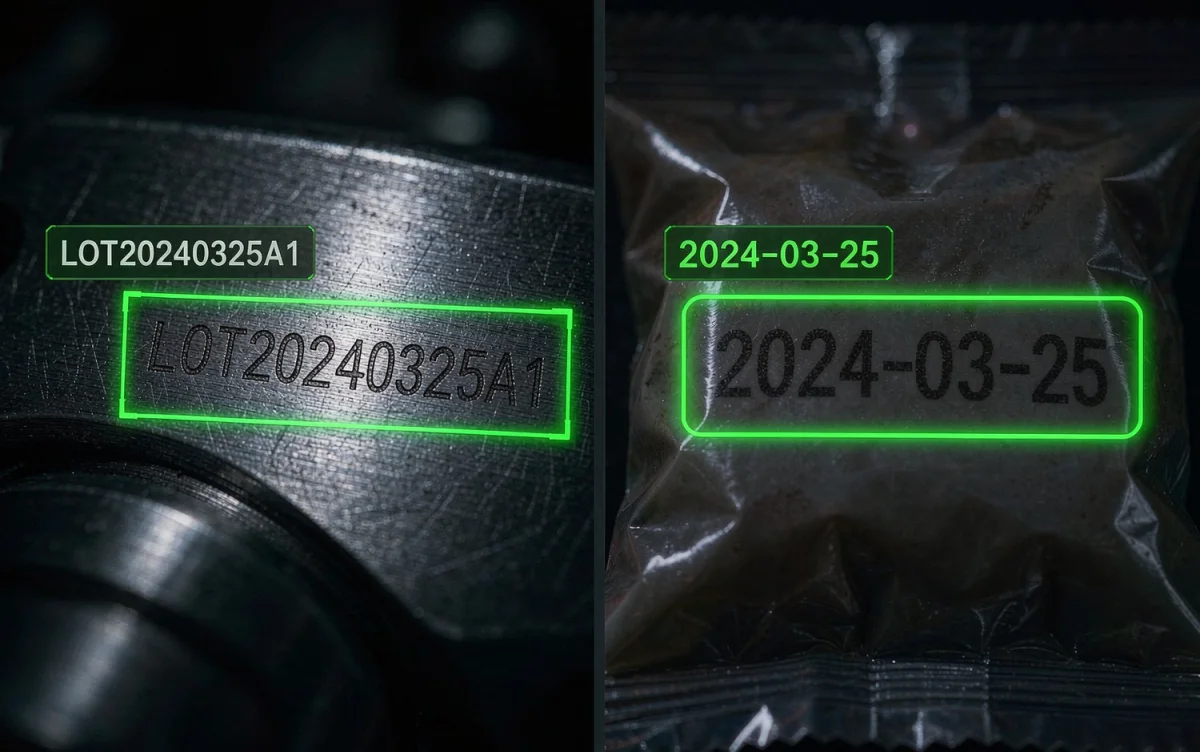
Industrial OCR character visual inspection: reads printed text, inkjet codes, laser marking, and batch information on the product surface, and determines whether the characters are present, legible, and correct in content, with OK/NG output after comparison against the expected content. The solution consists of three parts: imaging, algorithm, and interlocking; the judgement threshold must be biased according to the asymmetric cost of escapes and false rejections, and is subject to the results of a measured sample trial.
The difference between industrial OCR and document OCR is that characters at the industrial site may Printed on curved surfaces, metal, plastics, it may be reflective, oily or low contrast, and it may be sprayed crooked, printed too faintly or doubled. How high the recognition rate is depends largely on the optical conditions rather than on the algorithm itself.
In inspection applications, OCR usually does more than "read out characters"; it must also answer three questions: Whether the characters are present (presence/absence, missing print), Whether the content is correct (whether it matches the work order), Whether the quality is adequate (whether it is clearly legible). The acceptance criteria for the three questions are all different.
inspection Content
Items to verify on site for "industrial OCR character visual inspection", listed by common case
Character Presence/Absence
- Missing inkjet print
- Missing engraving
- Batch code not printed
- Serial number not printed
Content Comparison
- Model Mismatch
- Wrong batch
- Duplicate or skipped serial numbers
- Abnormal Date Format
Quality Judgement
- Blurred character
- Incomplete print
- Ghosting
- Uneven print density
Position Check
- Character Position Offset
- Outside the Specified Area
- Mark pressed to the edge
- Excessive Angle Tilt
Multi-region recognition
- Main label + secondary label
- Multi-side marking
- 1D barcode + characters
- Multiple Fields in the Label
Confusable characters
- 0 and O
- 1 and I
- 8 and B
- 5 and S
inspection Method
From trigger and acquisition to result output, how the judgement is produced
- 01 Workpiece-in-Place Trigger
- 02 image acquisition
- 03 Character Area Positioning
- 04 Character segmentation and recognition
- 05 Compare with the expected content
- 06 Quality and position judgement
- 07 Output OK / NG
- 08 PLC interlocking
- 09 Release / Quarantine
The first means of making OCR stable is illumination: The contrast between the print and the background sets the upper limit of recognition difficulty. Engraved characters on metal parts usually use coaxial light or low-angle grazing light to highlight the raised and recessed features, while inkjet codes usually use diffuse light to prevent reflection from drowning out the characters.
The second measure is Limit the Recognition Area: Restricting recognition to a specified region (ROI) and limiting the character set (for example, digits only, fixed length only) can significantly reduce the misrecognition rate. Industrial OCR does not need generality; it only needs to be stable at this station.
judgement and Interlocking
How results are judged and passed to the production line
| Recognition Status | judgement | Interlocking Action |
|---|---|---|
| Characters recognized and matching expectation | OK | release |
| No Characters Recognized | NG | Treat as a missing print |
| Characters recognized but not matching expectation | NG | Treated as a misprint, with a prompt to check the work order |
| Low recognition confidence / insufficient sharpness | re-inspection | Re-capture or manual confirmation |
"Low recognition confidence" and "content mismatch" should be handled separately: the former is mostly an imaging or print quality problem, and the latter is mostly a work order or material problem. Mixing them together leaves on-site troubleshooting without direction.
For easily confused characters (0/O, 1/I), it is recommended to add after recognition Business Rule Validation, such as check digits, fixed prefixes and length rules. Rule validation is more reliable than relying on the algorithm alone to distinguish characters.
Related Inspection Objects
View more specific object characteristics, acceptance criteria and optical notes by object
Applicable Industry
Scenarios in These Industries That Already Have Corresponding Inspection Needs
Common Question
Questions most often asked during selection and implementation
Can Engraved Characters on Metal Surfaces Be Recognized?
Yes, but the illumination must be designed for the raised and recessed features of the engraving (grazing light and coaxial light are common choices). Metal reflection is the main interference, and the mounting angle usually also needs adjusting so that specular reflection does not enter the lens.
Can Characters on Curved Surfaces Be Recognized?
Yes, but a curved surface causes character deformation and local defocus, so the mounting angle, depth of field and illumination must be designed specifically for it. When the curvature is too great, multiple shots or multiple cameras may be required.
What is the difference between OCR and code reading?
Code reading decodes a barcode / QR code into a character string, with high robustness and speed; OCR recognizes human-readable characters directly from the image, which is flexible but more sensitive to imaging quality. Which to choose depends on what is printed on the product and whether encoded redundancy is required.
What recognition rate can be guaranteed?
Any recognition rate promised without physical validation is unreliable. Recognition performance depends jointly on character size, contrast, the printing process, illumination, and the mounting method, and should be confirmed through actual sample testing rather than calculated from algorithm metrics.
How are the acceptance criteria for this solution defined?
"Low recognition confidence" and "content mismatch" should be handled separately: the former is mostly an imaging or printing quality problem, while the latter is mostly a work order or material problem. Mixing them together leaves on-site troubleshooting without direction. For easily confused characters (0/O, 1/I), we recommend adding business rule validation after recognition, for example a check digit, a fixed prefix or a length rule. Rule validation is more reliable than relying on the algorithm alone to distinguish characters.
What is the inspection method?
The first means of making OCR stable is illumination: the contrast between the printed characters and the background sets the upper limit of recognition difficulty. Engraved characters on metal parts are usually lit with coaxial or low-angle grazing light to bring out the relief; inkjet codes usually use diffused light to keep reflections from drowning the characters. The second means is to limit the recognition range: having the equipment recognize only within a specified region (ROI) and restricting the character set (for example digits only, fixed length only) can significantly reduce the misrecognition rate. Industrial OCR does not need generality; it only needs to be stable at this station.
Which Inspection Objects Is This Solution Applicable To?
View the object characteristics, acceptance criteria and optical considerations for each object; it covers 8 common object types including label presence/absence inspection, PCB component presence/absence inspection, terminal presence/absence inspection and connector presence/absence inspection.
Can this solution replace manual labor?
What visual inspection replaces is repetitive visual judgement, not manual labor for everything. The typical division of labor is: vision performs part-by-part full inspection and judgement, while people handle re-judgement of borderline samples, changeovers and exceptions, and maintenance of the optics and tooling. How many people are actually involved depends on the degree of automation and the re-judgement strategy.
How do you verify that this solution is feasible?
Please provide actual product samples printed with characters (including good parts and parts with known missing print or blurring), and our engineers will test the recognition performance under the actual optical conditions.
Submit sample testing
Please provide actual product samples printed with characters (including good parts and parts with known missing print or blurring), and our engineers will test the recognition performance under the actual optical conditions.
Submitted successfully
We have received your sample testing request. A solution engineer will contact you within 1 business day via contact you.
Need to assess imaging conditions, defect criteria and cycle time item by item? Go to the Full Requirement Assessment →
Submit Samples to Get a Visual Inspection Solution
Tell us the workpiece, inspection requirements, production line cycle time and your existing PLC / communication method, and our solution engineers will recommend the inspection method, optical configuration and interlocking solution.