Cosmetics
For cosmetics filling and packaging, providing visual inspection solutions for appearance, labeling, decorative part assembly and packaging content verification.
Industry Production characteristics
How This Industry Produces Determines How Inspection Should Be Done
The visual inspection of cosmetics revolves around two things: first, making the most common defects in this industry image clearly and consistently; second, connecting the judgement result reliably into the production line. Common implementation constraints in this industry are "glass and acrylic are highly reflective, so defect visibility depends on the lighting angle"; "dark bottle bodies absorb light, making details hard to reveal". Whether detection can be stable depends on material optical properties, minimum defect size, and cycle time, and is subject to the results of a measured sample trial.
Cosmetics is Highest appearance sensitivity one of the consumer product categories: a single scratch, a slight color deviation or a crooked label can lead directly to a return.
At the same time, packaging formats in this category are extremely diverse — glass bottles, acrylic, tubes, metal shells — and the imaging conditions differ for every material, The optical solution must be confirmed almost model by model.
Industry Inspection issues
Where problems actually occur on site
- Label misaligned, lifting or wrong orientation
- Bottle body scratches, dirt, fingerprints
- Decorative part (hot stamping, screen printing) defects
- Pump head / cap not fully seated
- Missing packaging accessories
Typical Inspection Objects
The Most Common Inspection Objects in This Industry
Typical Inspection Task
The judgments to be made on these objects
- Label position and orientation verification
- Bottle body appearance inspection
- Decorative part defect recognition
- Assembly Seating Confirmation
- Packaging content verification
Vision Inspection Challenges
Implementation constraints specific to this industry
- Glass and acrylic are highly reflective, so defect visibility depends on the illumination angle
- Dark bottle bodies absorb light, so details are hard to reveal
- Measuring labels on curved bottles is complex
- Many categories, relatively small single-batch volumes, frequent changeovers
Choosing the right algorithm
Choose by Acceptance Criteria Form, Not by How Advanced It Is
Anomaly Detection
Appearance defects are difficult to enumerate, so model the normal state
Geometric Measurement
Label position and angle measurement
Region presence
Presence/absence of assembled parts and accessories
acquisition and light source
Optical conditions set the upper limit of feasibility
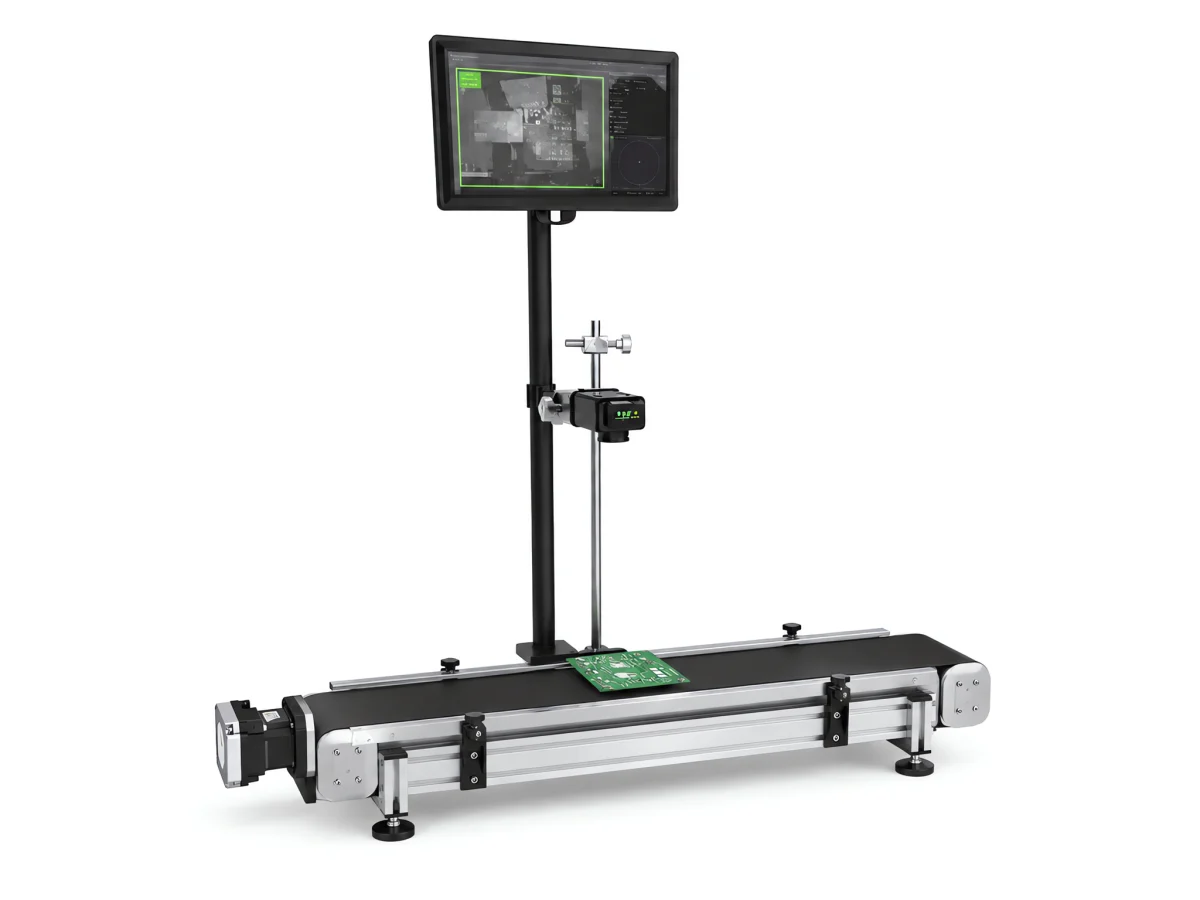
- Multi-angle illumination is the key to appearance inspection: scratches in different directions only become visible at different angles of incidence
- For highly reflective materials, a combination of a diffusion dome and polarization is recommended
- For dark bottles, increase illuminance and avoid highlight overflow
OK / NG Judgement
How results are judged and used
| Inspection Status | judgement | Interlocking Action |
|---|---|---|
| Appearance and assembly pass | OK | release |
| Appearance defect or label anomaly | NG | Reject to keep it out of the market |
| Incomplete Assembly | NG | Re-inspection After Rework |
PLC and Automation Interlocking
How results connect to the production line
For appearance defects, we recommend keeping images to support communication and improvement with the supplier or the production step.
For multi-category switching, have the host system issue the recipe to reduce manual selection errors.
Applicable equipment
Common configuration forms for this type of inspection
Related Solutions
View the corresponding solution by inspection task
Common Question
The Questions Most Often Asked in This Industry
Can scratches on glass bottles be detected?
It depends on the relationship between the scratch direction and the illumination direction. A scratch only becomes visible at a specific angle of incidence, so appearance inspection usually requires multi-angle illumination or multiple captures. Feasibility must be validated with actual samples.
Can fingerprints and dirt be detected?
These defects have extremely low contrast, are difficult to inspect, and are easily confused with normal texture. It is recommended to first define "which stains are unacceptable", and to validate the detectable level with actual samples rather than making blanket commitments.
For visual inspection in this industry, what needs to be solved first?
The implementation constraints commonly seen in this industry center on: "glass and acrylic are highly reflective, so defect visibility depends on the illumination angle"; "dark bottles absorb light, making details hard to reveal"; "measuring labels on curved bottle bodies is complex". These constraints affect both the imaging solution and the cycle-time design. Normally a sample trial is needed to validate before the configuration is finalized.
How does the inspection result interlock with the production line?
For appearance-related defects, keep the images so they can be shared with suppliers or the production side for improvement. When switching between multiple product types, have the host system issue the recipe to reduce manual selection errors.
What Equipment Configuration Does This Type of Inspection Generally Require?
Common forms include: "multi-angle appearance inspection cell", "post-labelling inspection station", "inspection device that works with the cartoning machine". The specific machine model and quantity depend on the inspection area, the minimum defect size and the line cycle time, and must be confirmed according to the site conditions.
Which process steps in this industry benefit most from a visual inspection station?
The most common are: "label position and orientation verification"; "bottle body appearance inspection"; and "decorative part defect identification". Which process steps to actually instrument depends on the cost of defects escaping downstream and of rework — the later a defect is found, the higher the cost.
How do we judge whether our product is suitable for visual inspection?
Please provide samples of each bottle body and label (including parts with known appearance defects); our engineers will assess the illumination solution and the detectable level. In general, as long as the acceptance criteria can be stated clearly, the defects can image clearly and consistently, and the cycle time matches the field of view, the project's feasibility is confirmed.
What inspection accuracy can be achieved?
Accuracy is not a fixed value that holds regardless of conditions. To be added — the minimum detectable size depends on the combination of field of view and camera resolution, and is also affected by illumination, lens and algorithm; the configuration must be derived from your minimum defect size and validated by measurement.
Submit sample testing
Please provide samples of each bottle body and label (including known appearance defects); our engineers will assess the illumination solution and the degree of detectability.
Submitted successfully
We have received your sample testing request. A solution engineer will contact you within 1 business day via contact you.
Need to assess imaging conditions, defect criteria and cycle time item by item? Go to the Full Requirement Assessment →
Inspection Configuration Based on Your Industry's Products and Cycle Time
Send us photos of the workpiece, the inspection requirement (what to inspect, and the tolerance for escapes and false calls), and the line cycle time, and our solution engineers will recommend the inspection method, optical solution, and interlocking configuration for that industry.