Garment
Inline visual inspection for garment cut pieces and fabric, identifying stains, holes, print misalignment, cutting loss and other defects, suited to multi-layer cut pieces and fast repeat-order scenarios.
Industry Production characteristics
How This Industry Produces Determines How Inspection Should Be Done
Visual inspection for garments centers on two things: first, imaging the industry's most common defects clearly and consistently, and second, connecting the judgement results reliably into the production line. Common implementation constraints in this industry are "flexible cut pieces crease easily and their edges curl, so they must be smoothed flat or held by vacuum before imaging" and "printed patterns, stripes and checks form a strong background texture that must be distinguished from defects". Whether defects can be detected consistently depends on the material's optical properties, the minimum defect size and the cycle time, and is subject to the results of a measured sample trial.
The quality inspection challenges in garment production lie in Cut pieces are flexible and irregular in shape, and patterns such as prints, jacquard, and stripes are themselves background texture during imaging — they are not defects but they interfere with defect recognition. A garment often moves through the line as cut pieces before it is stitched, and this is when detecting defects costs the least.
The garment industry also Frequent repeat orders, small batches, tight lead times, manual fabric and cut piece inspection struggles to maintain a consistent judgement scale with mixed styles, mixed colors and multi-layer spreading, and this is where machine vision is more consistent.
Industry Inspection issues
Where problems actually occur on site
- Spread layers of stacked cut pieces make it hard to trace a single-layer flaw to a specific piece
- Patterns such as prints, stripes and checks are misjudged as defects
- Different dye lots in the same batch show color differences and must be compared under the same light source
- Cut damage, holes and pulled threads are easily missed under flexible deformation
- High rework cost, quick repeat orders, insufficient coverage from manual sampling
Typical Inspection Objects
The Most Common Inspection Objects in This Industry
Typical Inspection Task
The judgments to be made on these objects
- Recognition of stains, oil marks and off-color on cut piece surfaces
- Identification of holes, pulled threads, cutting damage and other defects
- Checking print / embroidery position and misalignment
- Verification of cut-piece contour dimensions and alignment marks
- Color difference comparison within a cut-piece batch
Vision Inspection Challenges
Implementation constraints specific to this industry
- Flexible cut pieces wrinkle easily and their edges curl, so they must be smoothed or vacuum-held before imaging
- Printed patterns, stripes, and checks form strong background texture and must be distinguished from defects
- When material is laid up in multiple layers, determining which ply a defect belongs to requires segmentation or layer-by-layer imaging
- Fabric from different dye lots differs inherently, so color difference criteria must be based on the standard sample from the same batch
- Dark stains on dark fabric and light dirt on light fabric both have low contrast
Choosing the right algorithm
Choose by Acceptance Criteria Form, Not by How Advanced It Is
Texture Suppression + Defect Segmentation
Use texture decoupling or reference pattern alignment to subtract the print / plaid pattern as a known background before inspecting anomalous regions
Color and Color Difference Comparison
Color difference is quantified against a standard sample under the same light source, distinguishing inherent dye lot variation from abnormal color contamination
Contour and Dimensional Measurement
After cut piece edge extraction, measure dimensions and distances to alignment marks
acquisition and light source
Optical conditions set the upper limit of feasibility
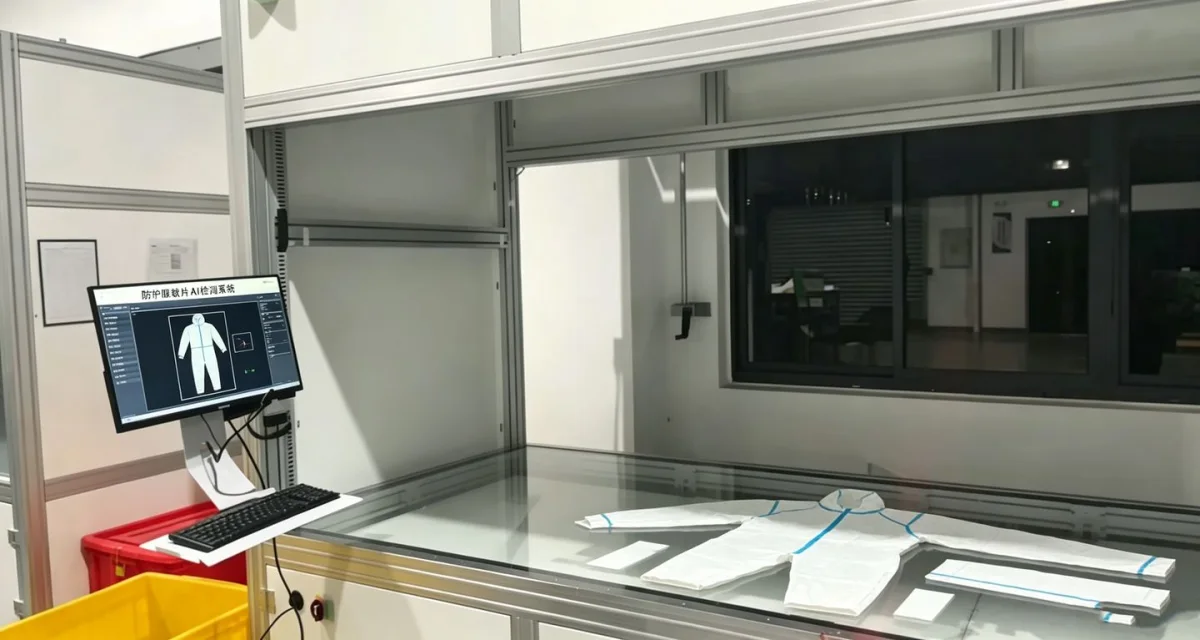
- Light flexible surfaces with diffuse or shadowless light so that wrinkle shadows are not misjudged
- Color difference comparison requires uniform illumination across the whole web and a fixed relative position between light source and camera
- Switching between dark and light colors may require adjusting exposure or filtering, and channel-specific processing if necessary
OK / NG Judgement
How results are judged and used
| Inspection Status | judgement | Interlocking Action |
|---|---|---|
| Cut pieces free of stains and holes, with correct dimensional alignment | OK | Release to the sewing process step |
| Stains / holes / print misregistration present | NG | Mark and reject, preventing flow into sewing |
| Color difference in the same batch exceeds the datum | NG | Whole-batch re-inspection or sample retention for confirmation |
PLC and Automation Interlocking
How results connect to the production line
It is recommended to set up an inspection station at the spreading or after-cutting step, so that defective cut pieces are rejected directly rather than waiting for rework at the finished garment stage — the manual labour and time cost of garment rework is far higher than rejecting a single piece.
When repeat orders are frequent, make the pattern, colorway and color-difference datum of each cut-piece style into an inspection recipe called up by work order number or barcode, to reduce acceptance criteria drift caused by manual switching.
Applicable equipment
Common configuration forms for this type of inspection
Related Solutions
View the corresponding solution by inspection task
Common Question
The Questions Most Often Asked in This Industry
How do you locate a specific layer in a multi-layer stack?
The common approach is to load cut pieces in a single layer into inspection, or to use layered imaging / edge recognition after fabric spreading to distinguish the layer sequence. The specific solution depends on the spreading method and equipment layout; photos of the number of spread layers are best provided for evaluation.
Will printed patterns trigger false calls?
Yes, and this is exactly the core difficulty of garment inspection. Texture decoupling is normally used: the known print / check pattern is subtracted as a reference background, and only areas that deviate from that background trigger an alarm. The reference image must be switched with the style number.
How Are Color Differences Between Dye Lots Handled?
Color difference acceptance criteria should be based on Same-Batch Reference Sample as the datum, rather than absolute color values across batches. The system quantifies the color difference between the piece under inspection and the standard sample, and only values exceeding the set threshold are judged abnormal. Thresholds must be set according to the fabric and the customer complaint standard.
What Is the Smallest Defect That Can Be Detected?
The minimum detectable size depends on camera resolution, inspection field of view, and imaging sharpness, which together determine the physical size represented by one pixel. The specific lower detection limit must be worked back from the minimum defect size and measured. To be added.
Repeat Orders Turn Around Fast; Is Switching Style a Hassle?
It is recommended to make the pattern, color scheme and color difference datum of each style a separate inspection recipe, called up automatically by work order number or barcode when the style is changed. Recipe management itself requires investment, but it prevents errors in manual switching.
Can dark stains on dark fabric be inspected?
When contrast is low, brightness alone is hard to distinguish; multispectral or polarization can enhance material differences, combined with texture anomaly judgement where necessary. Actual performance must be validated on real stain samples.
Can inspection fully replace manual fabric inspection?
Visual inspection is better suited to controlling the stability of repeatable, quantifiable acceptance criteria; it cannot replace manual labor for subjective indicators such as drape and hand feel. The two are usually complementary rather than substitutes for each other.
For visual inspection in this industry, what needs to be solved first?
The implementation constraints commonly seen in this industry center on: "flexible cut pieces wrinkle easily and their edges curl, so they must be smoothed or vacuum-held before imaging"; "printed patterns, stripes and checks form strong background textures that must be distinguished from defects"; "when multiple layers of material are spread, determining which piece a fault belongs to requires segmentation or layer-by-layer imaging". These constraints affect both the imaging solution and the cycle-time design. Normally a sample trial is needed to validate before the configuration is finalized.
How does the inspection result interlock with the production line?
We recommend setting up an inspection station at the spreading or post-cutting step and rejecting defective cut pieces immediately, rather than waiting until the garment is finished and reworking it; the labor and time cost of garment rework is far higher than rejecting a single piece. When repeat orders are frequent, we recommend turning the pattern, color scheme and color-difference datum of each cut piece style into an inspection recipe, recalled by work order number or barcode, to reduce acceptance criteria drift caused by manual switching.
What Equipment Configuration Does This Type of Inspection Generally Require?
Common forms include: "garment cut-piece inspection equipment", "AI vision cut-piece inspection equipment", "outdoor apparel inspection equipment". The specific machine model and quantity depend on the inspection area, the minimum defect size and the line cycle time, and must be confirmed according to the site conditions.
Which process steps in this industry benefit most from a visual inspection station?
The most common are: "recognition of stains, oil marks and off-color areas on cut-piece surfaces"; "identification of damage such as holes, pulled threads and cutting damage"; "checking print / embroidery position and misalignment." Which process steps to actually instrument depends on the cost of defects escaping downstream and the cost of rework — the later a defect is found, the higher the cost.
How do we judge whether our product is suitable for visual inspection?
Please provide cut-piece samples (including samples with known stains, holes, and print misalignment), a description of the number of layers spread, and the reorder frequency, and our engineers will evaluate the imaging method and the recipe management approach. Generally speaking, as long as the acceptance criteria can be stated clearly, the defects can image clearly and consistently, and the cycle time matches the field of view, the project is feasible.
What inspection accuracy can be achieved?
Accuracy is not a fixed value that holds regardless of conditions. To be added — the minimum detectable size depends on the combination of field of view and camera resolution, and is also affected by illumination, lens and algorithm; the configuration must be derived from your minimum defect size and validated by measurement.
Submit sample testing
Please provide cut-piece samples (including samples with known stains, holes and print misalignment), a description of the number of layers spread, and the repeat-order frequency; our engineers will assess the imaging method and the recipe management approach.
Submitted successfully
We have received your sample testing request. A solution engineer will contact you within 1 business day via contact you.
Need to assess imaging conditions, defect criteria and cycle time item by item? Go to the Full Requirement Assessment →
Inspection Configuration Based on Your Industry's Products and Cycle Time
Send us photos of the workpiece, the inspection requirement (what to inspect, and the tolerance for escapes and false calls), and the line cycle time, and our solution engineers will recommend the inspection method, optical solution, and interlocking configuration for that industry.