Home Appliance
For complete home appliance assembly and packaging, providing visual inspection solutions for component assembly, missing accessories, labels and appearance verification.
Industry Production characteristics
How This Industry Produces Determines How Inspection Should Be Done
The visual inspection of home appliances revolves around two things: first, making the most common defects in this industry image clearly and consistently; second, connecting the judgement result reliably into the production line. Common implementation constraints in this industry are "the internal structure of the complete machine is compact, with severe occlusion"; "large parts have very large appearance surfaces that a single camera struggles to cover". Whether detection can be stable depends on material optical properties, minimum defect size, and cycle time, and is subject to the results of a measured sample trial.
The home appliance industry is characterized by High output, many models, strict appearance requirements. Rework after complete machine assembly is very costly, so inspection points are usually moved forward to the final assembly and packaging process steps.
Also, for home appliances, the Accessories and packaging contents This is a frequent source of complaints: a missing instruction manual, accessory pack or warranty card translates directly into after-sales cost.
Industry Inspection issues
Where problems actually occur on site
- Missing internal fasteners or clips
- Harness not fully seated or abnormal routing
- Missing accessory or instruction manual
- Label missing or misaligned
- Appearance scratches and dirt
Typical Inspection Objects
The Most Common Inspection Objects in This Industry
Typical Inspection Task
The judgments to be made on these objects
- Verification of internal assembly elements
- Harness connection and routing check
- Carton accessory verification
- Label and energy efficiency marking check
- Appearance anomaly identification
Vision Inspection Challenges
Implementation constraints specific to this industry
- The complete machine has a compact internal structure with severe occlusion
- Large parts have very large appearance surfaces, so a single camera cannot cover them
- Multiple models on one line, many recipes
- Limited lighting conditions inside the packaging
Choosing the right algorithm
Choose by Acceptance Criteria Form, Not by How Advanced It Is
Multi-region verification
Judged item by item by assembly point
Anomaly Detection
Appearance defect recognition
Region presence
Presence/absence of accessories and instruction manual
acquisition and light source
Optical conditions set the upper limit of feasibility
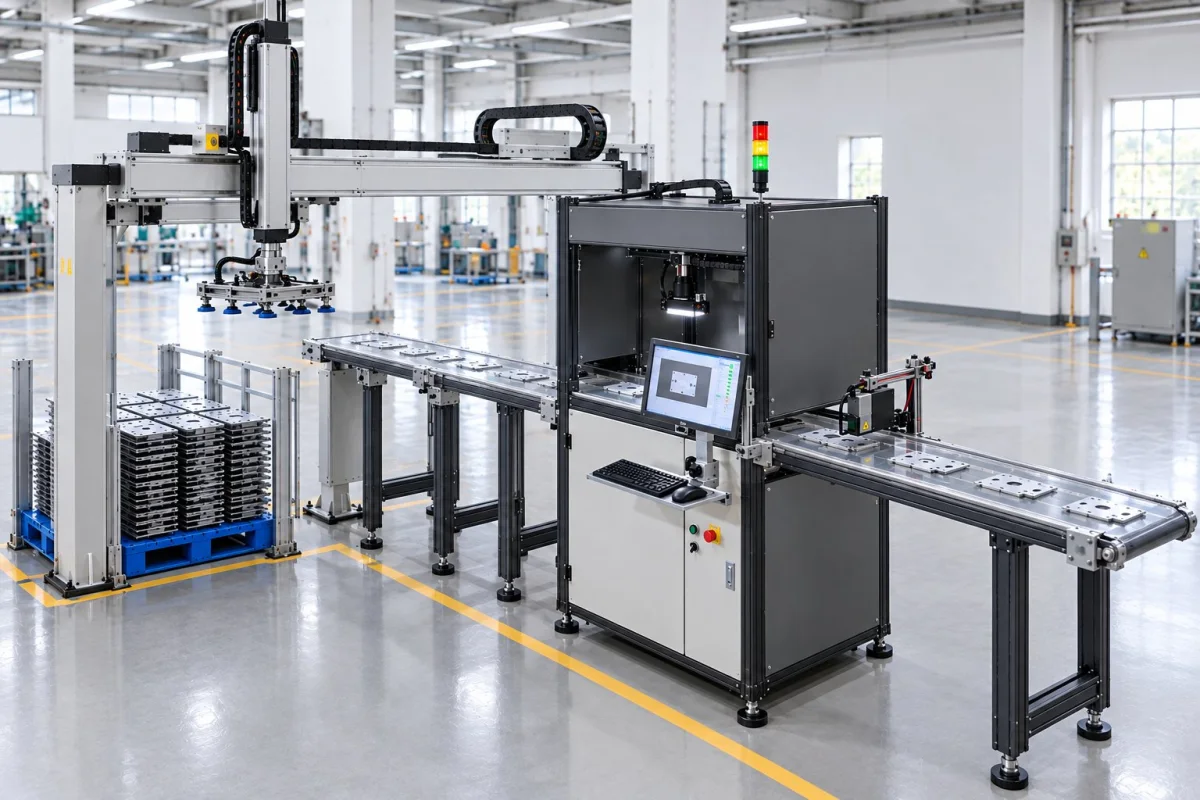
- For internal inspection, miniaturized light sources with light-guide structures are recommended
- For appearance inspection, use multi-angle illumination to reveal scratches in different directions
- In-package inspection needs dedicated fill lighting to avoid shadow obstruction
OK / NG Judgement
How results are judged and used
| Inspection Status | judgement | Interlocking Action |
|---|---|---|
| Assembly and packaging contents complete | OK | Release and Packing |
| Missing part / omitted placement present | NG | Block, replenish the part and re-inspect |
| Appearance Defect | NG | Route to rework or downgrade |
PLC and Automation Interlocking
How results connect to the production line
It is advisable to split assembly inspection and packaging inspection into two stations so that a single point of failure does not affect the whole line.
On mixed-model lines, the model is issued by the PLC or work order system, automatically recalling the corresponding recipe.
Applicable equipment
Common configuration forms for this type of inspection
Related Solutions
View the corresponding solution by inspection task
Common Question
The Questions Most Often Asked in This Industry
Can the interior of the complete machine be inspected?
It depends on whether a viewing window and space are available. Some process steps require inspection before the cover is closed, or the use of compact cameras and light-guide illumination. It is recommended to reserve an inspection position at the process design stage.
The appearance surface is very large — how are scratches covered?
Multiple cameras or multi-angle illumination covering zones separately are usually used. The most critical part of appearance inspection is the lighting design — scratches at different angles only appear under incident light from different directions.
For visual inspection in this industry, what needs to be solved first?
The implementation constraints commonly seen in this industry center on: "the internal structure of the complete machine is compact with severe occlusion"; "large parts have very large appearance areas that are difficult for a single camera to cover"; "many models are mixed on one line, requiring many recipes". These constraints affect both the imaging solution and the cycle-time design. Normally a sample trial is needed to validate before the configuration is finalized.
How does the inspection result interlock with the production line?
It is recommended to split assembly inspection and packaging inspection into two stations to avoid a single point of failure affecting the full line. When multiple models are mixed on one line, the PLC or work order system issues the model and the corresponding recipe is called up automatically.
What Equipment Configuration Does This Type of Inspection Generally Require?
Common forms include: "EEK-SV5205C industrial vision presence/absence inspection equipment", "final assembly inspection station", and "carton content verification station". The specific machine model and quantity depend on the inspection area, minimum defect size, and line cycle time, and must be confirmed against the site conditions.
Which process steps in this industry benefit most from a visual inspection station?
The most common are: "internal assembly element verification"; "wire harness connection and routing inspection"; and "carton accessory verification". Which process steps to actually instrument depends on the cost of defects escaping downstream and of rework — the later a defect is found, the higher the cost.
How do we judge whether our product is suitable for visual inspection?
Please provide assembly photos of the complete machine, a packing list, and a description of the appearance requirements, and state the inspection space available. In general, as long as the acceptance criteria can be stated clearly, defects image clearly and consistently, and the cycle time matches the field of view, the project is feasible.
What inspection accuracy can be achieved?
Accuracy is not a fixed value that holds regardless of conditions. To be added — the minimum detectable size depends on the combination of field of view and camera resolution, and is also affected by illumination, lens and algorithm; the configuration must be derived from your minimum defect size and validated by measurement.
Submit sample testing
Please provide complete machine assembly photos, the packing content list and the appearance requirement description, and state the available inspection space.
Submitted successfully
We have received your sample testing request. A solution engineer will contact you within 1 business day via contact you.
Need to assess imaging conditions, defect criteria and cycle time item by item? Go to the Full Requirement Assessment →
Inspection Configuration Based on Your Industry's Products and Cycle Time
Send us photos of the workpiece, the inspection requirement (what to inspect, and the tolerance for escapes and false calls), and the line cycle time, and our solution engineers will recommend the inspection method, optical solution, and interlocking configuration for that industry.