Home Textiles
For large-format continuous inspection of home textile fabric, curtains and bedding, line-scan cameras perform swath stitching and equidistant imaging to handle periodic texture interference from jacquard and printed patterns.
Industry Production characteristics
How This Industry Produces Determines How Inspection Should Be Done
The visual inspection of home textiles revolves around two things: first, making the most common defects in this industry image clearly and consistently; second, connecting the judgement result reliably into the production line. Common implementation constraints in this industry are "large formats require a line-scan camera with frame-by-frame stitching, and seams are prone to misalignment"; "jacquard / printed fabrics have a strongly periodic background, where defects share the same frequency as the texture". Whether detection can be stable depends on material optical properties, minimum defect size, and cycle time, and is subject to the results of a measured sample trial.
Home textile fabrics are usually large-format with continuous feed: curtains, bedding, and sofa fabric are often wide and come in long rolls, so inspection tends to use Line-Scan Camera Continuous imaging along the material travel direction, not a single area-scan frame.
These fabrics often have Repeating patterns such as jacquard and print, forming a strongly periodic background; weaving defects, stains and holes fall on this periodic texture and must be decoupled from the texture, otherwise they are drowned out by the periodicity.
Industry Inspection issues
Where problems actually occur on site
- Large-format continuous feeding makes stitching across segments difficult
- Jacquard / printed periodic texture masks defects
- Uneven material travel speed causes deviation in equally spaced imaging
- Long rolls make tiny stains prone to escape
- Color difference between dye lots of the same pattern
Typical Inspection Objects
The Most Common Inspection Objects in This Industry
Typical Inspection Task
The judgments to be made on these objects
- Weaving defect, yarn breakage and hole identification
- Extracting defects from periodic jacquard / printed textures
- Print misalignment and registration check
- Stain, foreign matter and color difference recognition
- Area subdivision stitching and continuous imaging calibration
Vision Inspection Challenges
Implementation constraints specific to this industry
- Large formats require line-scan cameras with frame stitching; seams are prone to misalignment
- Jacquard / printed backgrounds are strongly periodic, so defects share the frequency of the texture
- Fluctuations in material feed speed affect equal-interval imaging and dimensional measurement
- Continuous inspection of long rolls places high demands on stability and heat dissipation
- The same pattern from different dye lots has inherent color differences
Choosing the right algorithm
Choose by Acceptance Criteria Form, Not by How Advanced It Is
Line-Scan Stitching + Periodic Modeling
Line scan images continuously and then stitches frames, with periodic modeling to subtract the background for jacquard / printed patterns
Pattern Registration and Misalignment Inspection
Use the pattern repeat as the datum to detect print misalignment and inaccurate pattern registration
Multi-Scale Defect Segmentation
Multi-scale segmentation of stains and holes, with texture interference suppressed
acquisition and light source
Optical conditions set the upper limit of feasibility
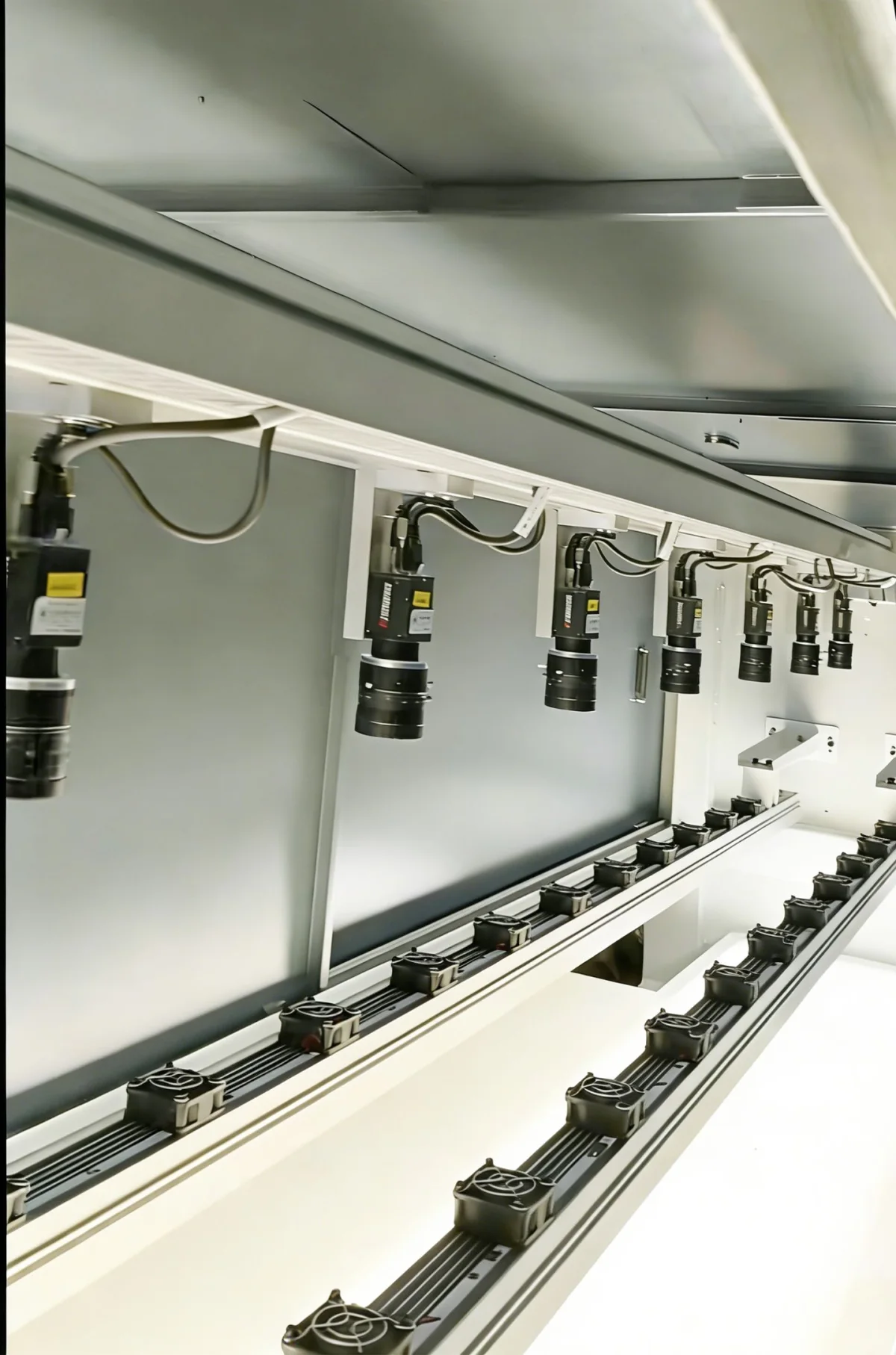
- For large areas, a line scan camera plus a uniform linear light source keeps illumination consistent across the area
- For jacquard fabric, low-angle light is recommended to highlight weave relief
- Color difference comparison requires uniform illumination across the full area and a fixed light source position
OK / NG Judgement
How results are judged and used
| Inspection Status | judgement | Interlocking Action |
|---|---|---|
| Weave defects within limits, no stains or holes, color difference compliant | OK | Release to Winding / Cutting |
| Detect weaving defects / stains / holes | NG | Mark the position; avoid or reject |
| Color difference in the same dye lot exceeds the datum | NG | Whole-roll re-inspection or sample retention |
PLC and Automation Interlocking
How results connect to the production line
For large-format continuous inspection we recommend integrating at the winding / fabric inspection stage, marking defect positions with roll-length coordinates so that later cutting can avoid them and whole-roll scrap is reduced.
The material running speed must be synchronized with the line-scan trigger; when the speed fluctuates, encoder feedback corrects for evenly spaced imaging.
Applicable equipment
Common configuration forms for this type of inspection
Related Solutions
View the corresponding solution by inspection task
Common Question
The Questions Most Often Asked in This Industry
Which camera is used for wide-format fabric?
Large-format continuous material feed usually favors Line-Scan Camera: Continuous imaging along the material travel direction, followed by frame-by-frame stitching. A single area-scan frame cannot cover the full width and has insufficient edge resolution.
Will jacquard and printed backgrounds hide defects?
Yes. The motif must be modeled by period, with the normal jacquard / print subtracted as background so that only residuals trigger an alarm. Pattern misalignment is another type of acceptance criterion, detected with the pattern repeat as the datum.
Does Unstable Material Feed Speed Affect Inspection?
Yes. Speed fluctuation changes the equidistant sampling of line-scan imaging and must be corrected with encoder feedback, otherwise dimensional measurement and position marking shift. The speed range must be confirmed during the solution stage.
What Is the Smallest Defect That Can Be Detected?
Determined by the line-scan resolution and the area field of view; it must be derived backward from the minimum defect size and measured. To be added.
How do you ensure no escapes on long rolls?
It relies on consistently stable imaging and algorithms, together with defect position coordinates marked for cutting avoidance. For long-term operation, light sources must be calibrated periodically so that brightness decay does not cause acceptance criteria drift.
How is color difference handled between dye lots of the same pattern?
Quantify color difference against a standard sample from the same dye lot rather than an absolute color value across lots. Establish the reference when each lot arrives.
Can Defects Escape at Panel Splices?
Stitched seams are a risk area, and the overlap and geometric alignment of adjacent frames must be ensured. The stitching algorithm and calibration quality directly determine whether escapes occur at the seam, and this must be verified with real images.
For visual inspection in this industry, what needs to be solved first?
the implementation constraints commonly seen in this industry center on: "Large formats require line-scan cameras with frame-by-frame stitching, and seams are prone to misalignment"; "Jacquard / printed backgrounds are strongly periodic, so defects share the same frequency as the texture"; "Fluctuation in material feed speed affects equally spaced imaging and dimension measurement". these constraints affect both the imaging solution and the cycle-time design. Normally a sample trial is needed to validate before the configuration is finalized.
How does the inspection result interlock with the production line?
For large-area continuous inspection, we recommend integrating it into the winding / fabric inspection step, marking defect positions with roll-length coordinates so that later cutting can avoid them and whole-roll scrapping is reduced. The material feed speed must be synchronized with the line-scan trigger, and when the speed fluctuates, encoder feedback corrects for evenly spaced imaging.
What Equipment Configuration Does This Type of Inspection Generally Require?
Common forms include: "advanced materials inspection equipment", "AI vision cut-piece inspection equipment", "new energy pouch material inspection equipment". The specific machine model and quantity depend on the inspection area, the minimum defect size and the line cycle time, and must be confirmed according to the site conditions.
Which process steps in this industry benefit most from a visual inspection station?
The most common are: "recognition of weaving defects, yarn breakage and holes"; "extracting defects from the periodic texture of jacquard / printed patterns"; "checking print misalignment and inaccurate pattern matching." Which process steps to actually instrument depends on the cost of defects escaping downstream and the cost of rework — the later a defect is found, the higher the cost.
How do we judge whether our product is suitable for visual inspection?
Please provide home textile fabric samples (including samples with weaving defects, print misalignment, and stains) along with the width, material travel speed, and roll length. In general, as long as the acceptance criteria can be stated clearly, defects image clearly and consistently, and the cycle time matches the field of view, the project is feasible.
What inspection accuracy can be achieved?
Accuracy is not a fixed value that holds regardless of conditions. To be added — the minimum detectable size depends on the combination of field of view and camera resolution, and is also affected by illumination, lens and algorithm; the configuration must be derived from your minimum defect size and validated by measurement.
Submit sample testing
Please provide home textile fabric samples (including weaving defects, print misalignment and stain samples) plus width, material running speed and roll length information.
Submitted successfully
We have received your sample testing request. A solution engineer will contact you within 1 business day via contact you.
Need to assess imaging conditions, defect criteria and cycle time item by item? Go to the Full Requirement Assessment →
Inspection Configuration Based on Your Industry's Products and Cycle Time
Send us photos of the workpiece, the inspection requirement (what to inspect, and the tolerance for escapes and false calls), and the line cycle time, and our solution engineers will recommend the inspection method, optical solution, and interlocking configuration for that industry.