Rail Transit
For visual inspection of rail vehicle interiors, seats and wear-resistant flame-retardant fabric, it emphasizes batch consistency and batch color difference, and clarifies the division of scope with performance testing such as delamination and flame retardancy.
Industry Production characteristics
How This Industry Produces Determines How Inspection Should Be Done
The visual inspection of rail transit revolves around two things: first, making the most common defects in this industry image clearly and consistently; second, connecting the judgement result reliably into the production line. Common implementation constraints in this industry are "dense weave of wear-resistant fabrics, so weaving defects have weak contrast against normal texture"; "in large-volume installations, small color differences are amplified many times over". Whether detection can be stable depends on material optical properties, minimum defect size, and cycle time, and is subject to the results of a measured sample trial.
Interior and seat fabrics for rail transit vehicles High volume, strict same-batch consistency requirements: Seats and trim surfaces on the same train and the same line must look uniform; any batch color difference or weaving defect is amplified once installed over a large area.
These fabrics are usually Wear-resistant, flame-retardant functional fabric, but at the visual inspection level only appearance can be judged — properties such as abrasion cycles and flame retardancy rating must be determined by dedicated physical and burn tests, and the division of labor must be stated clearly.
Industry Inspection issues
Where problems actually occur on site
- High-volume seats / interior fabrics demand high consistency
- Batch color difference is amplified after installation on the finished vehicle
- Wear-resistant fabrics are densely woven, so weave defects are hard to separate from texture
- Flame-retardant fabrics may have surface treatment anomalies
- Multiple trainsets of the same model; color differences across trainsets must be controlled
Typical Inspection Objects
The Most Common Inspection Objects in This Industry
Typical Inspection Task
The judgments to be made on these objects
- Seat / interior fabric: weaving defects and hole recognition
- Color difference comparison within batches and across groups
- Inspection of surface stains and treatment anomalies on flame-retardant fabric
- Wrap wrinkle and alignment offset verification
- Interior Trim Missing Part and Assembly Verification
Vision Inspection Challenges
Implementation constraints specific to this industry
- Wear-resistant fabrics have fine dense weaves, so weave defects contrast weakly with normal texture
- In high-volume installation, tiny color differences are amplified many times over
- Flame-retardant fabric finishing causes changes in gloss and texture
- Multiple production groups on the same model require a unified color reference
- Reflections and wrinkle shadows on curved wrapped parts interfere
Choosing the right algorithm
Choose by Acceptance Criteria Form, Not by How Advanced It Is
Fabric Periodic Modeling
Model the weave of abrasion-resistant fabric and alarm where the period deviates
Batch Color Difference Statistics
Use the first article / reference sample as a datum for batch and cross-group color difference statistics
Texture Anomaly Segmentation
Multi-scale segmentation of stains and scratches, with the weave background suppressed
acquisition and light source
Optical conditions set the upper limit of feasibility
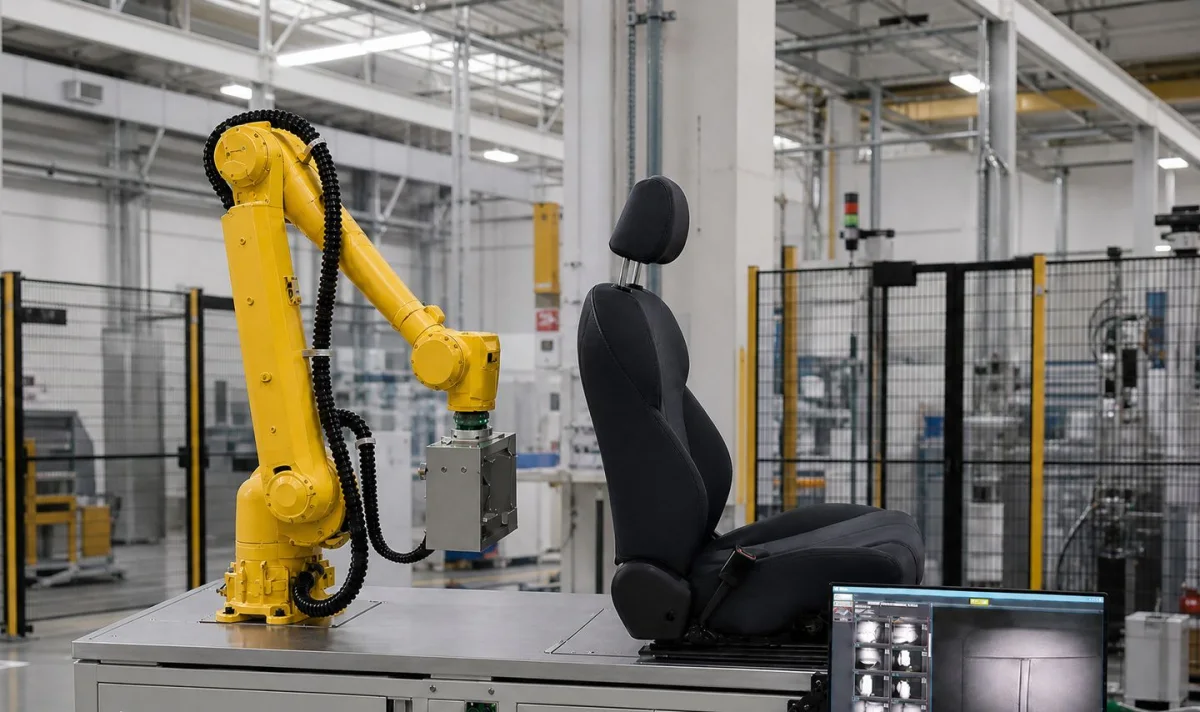
- For fine fabrics, use coaxial / diffuse light for even illumination to highlight weaving defects
- Color difference comparison requires uniform illumination across the full width and a fixed relative position
- For reflective wrapped parts, polarized light + diffusion is recommended to suppress highlights
OK / NG Judgement
How results are judged and used
| Inspection Status | judgement | Interlocking Action |
|---|---|---|
| Weaving defects within standard; color difference within reference | OK | Release for Installation |
| Weaving Defect / Stain Detected | NG | Reject or Bypass |
| Cross-batch color difference beyond the datum | NG | Whole-batch re-inspection or sample retention |
PLC and Automation Interlocking
How results connect to the production line
For high-volume fabric, we recommend batch sampling at the incoming material or cut-piece stage plus 100% inspection of critical parts, and re-inspection of whole batches whose color difference exceeds the baseline, to avoid large-scale rework after assembly.
Inspection results should be bound to the vehicle model / group number for traceability of consistency across groups.
Applicable equipment
Common configuration forms for this type of inspection
Related Solutions
View the corresponding solution by inspection task
Common Question
The Questions Most Often Asked in This Industry
How are weave defects distinguished from dense weave texture on abrasion-resistant fabric?
Abrasion-resistant fabric has a fine, regular weave and the normal structure can be modeled. Weaving defects (yarn breakage, skipped yarn, thick and thin places) disrupt that period, and any deviation detected triggers an alarm. A good-part woven sample is required.
What if batch color difference only becomes obvious on the vehicle?
Color difference statistics should be compiled at the incoming material stage using the same batch of standard samples, and anything beyond the datum is not laid up. The value of visual inspection is precisely to control color difference before assembly rather than reworking after it.
Can Vision Inspect Flame Retardancy?
No. Abrasion cycles, flame retardant ratings, and similar properties are determined by physical and burn tests, Vision judges appearance only (weaving defects, color difference, stains, scratches); the boundary with performance testing must be clearly defined.
What Is the Smallest Defect That Can Be Detected?
Determined by resolution and field of view; it must be derived from the minimum defect size and measured. To be supplemented.
How Is Color Difference Controlled Across Knitting Groups?
Using the first article / reference sample as the baseline, color difference comparison and statistics are performed for each build group of fabric, and batches exceeding the unified baseline are not mixed. The baseline must cover all build groups for the same vehicle model.
Will wrinkles on wrapped parts cause false calls?
Wrinkle shadows on curved covered surfaces are close to genuine indentations, so positional and shape criteria must be combined and polarization used to suppress reflection where necessary. Manual review is recommended for high-risk areas.
How Is Efficiency Maintained in Large Volumes?
Roll materials can be inspected continuously with line scan, with full inspection for critical parts and sampling for standard parts. Actual cycle time depends on the area and speed and must be calculated on site.
For visual inspection in this industry, what needs to be solved first?
the implementation constraints commonly seen in this industry center on: "Wear-resistant fabrics have a fine weave, so weave defects have weak contrast against the normal texture"; "In large-area installations, tiny color differences are magnified many times over"; "The surface treatment of flame-retardant fabrics brings changes in gloss and texture". these constraints affect both the imaging solution and the cycle-time design. Normally a sample trial is needed to validate before the configuration is finalized.
How does the inspection result interlock with the production line?
For large volumes of fabric, it is recommended to combine batch sampling at the incoming material or cut-piece stage with full inspection of critical pieces, and to re-inspect whole batches whose color difference exceeds the baseline, so as to avoid large-scale rework after the parts are installed in vehicles. Inspection results should be bound to the vehicle model / build group number to make consistency traceability across build groups easier.
What Equipment Configuration Does This Type of Inspection Generally Require?
Common forms include: "Automotive soft trim inspection equipment", "advanced materials inspection equipment". The specific machine model and quantity depend on the inspection area, minimum defect size and line cycle time, and must be confirmed according to the site conditions.
Which process steps in this industry benefit most from a visual inspection station?
The most common is: "identification of weaving defects and holes in seat / interior fabric"; "color difference comparison within the same batch and across trainsets"; "checking flame-retardant fabric for surface stains and treatment anomalies". Which process steps to actually instrument depends on the cost of defects escaping downstream and the cost of rework—the later a defect is found, the higher the cost.
How do we judge whether our product is suitable for visual inspection?
Please provide rail interior / seat fabric samples (including samples of weaving defects and batch color difference) and reference standards, and state the number of trainsets and whether flame-retardant fabric is included. In general, as long as the acceptance criteria can be stated clearly, the defects can image clearly and consistently, and the cycle time matches the field of view, the project's feasibility is confirmed.
What inspection accuracy can be achieved?
Accuracy is not a fixed value that holds regardless of conditions. To be added — the minimum detectable size depends on the combination of field of view and camera resolution, and is also affected by illumination, lens and algorithm; the configuration must be derived from your minimum defect size and validated by measurement.
Submit sample testing
Please provide rail interior / seat fabric samples (including samples of weaving defects and batch color difference) and reference samples, and state the number of train sets and whether flame-retardant fabric is included.
Submitted successfully
We have received your sample testing request. A solution engineer will contact you within 1 business day via contact you.
Need to assess imaging conditions, defect criteria and cycle time item by item? Go to the Full Requirement Assessment →
Inspection Configuration Based on Your Industry's Products and Cycle Time
Send us photos of the workpiece, the inspection requirement (what to inspect, and the tolerance for escapes and false calls), and the line cycle time, and our solution engineers will recommend the inspection method, optical solution, and interlocking configuration for that industry.