Why unmanned logistics perception systems determine the operating efficiency ceiling
Why unmanned logistics perception systems determine the operating efficiency ceiling
Unmanned logistics is moving from concept to large-scale application, and the perception system is the core foundation for this. Whether it is campus delivery, warehouse AGV, AMR or outdoor unmanned transport, a vehicle must accurately recognize its environment, judge obstacles, understand paths and adjust its behavior in real time in order to run reliably. Without reliable visual perception, unmanned logistics can hardly achieve genuine commercial deployment in complex environments.
The complexity of unmanned logistics scenarios lies in the fact that they combine structured indoor environments with dynamic outdoor changes; narrow aisles, racks and floor reflections coexist with pedestrian traffic, vehicle traffic and temporary obstacles. The perception system must remain stable under different lighting, different speeds and different spatial structures, and it must not only see but see accurately. Path recognition, obstacle detection and coordinated positioning are the keys to whether it can keep running.
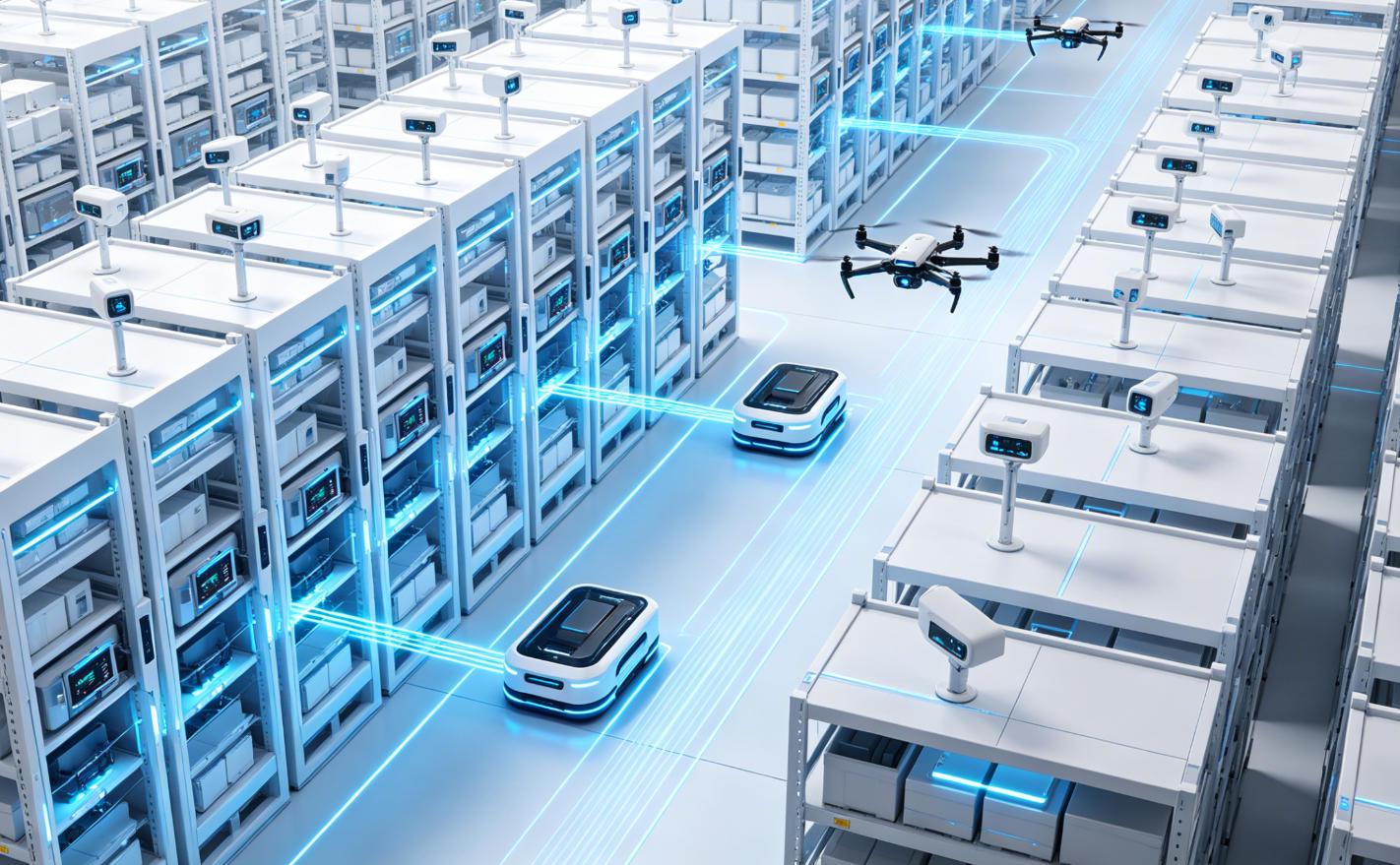
From a business perspective, the goal of unmanned logistics is not simply "replacing manual labor" but improving transport turnover efficiency, reducing repetitive work, cutting human error and increasing operational flexibility during peak periods. The more stable the perception system, the more confidently the scheduling system can assign more complex tasks to unmanned equipment. In other words, perception capability defines the operating boundary and determines how far a company can take unmanned operations.
The most common problem when implementing unmanned logistics projects is that the experimental environment differs too much from the real environment. A warehouse interior may be very tidy, but after long-term operation problems appear such as temporary stacking, floor stains, lighting changes, and worn labels. A perception system that can work over the long term must take these "non-ideal states" into account and expose risks earlier through stronger robustness and a more complete testing process.
The value EEK offers to the unmanned logistics industry lies in combining perception modules, system integration and manufacturing validation. For customers, the truly difficult part is never building a demo that runs, but making equipment work consistently and stably across multiple shifts, multiple environments and multiple batches. The end point of competition in unmanned logistics is in fact reliability, and reliability comes first from a stable perception system.
As warehouse automation and campus intelligence continue to advance, unmanned logistics will increasingly rely on high-quality perception to support scheduling, obstacle avoidance and safety coordination. Whoever builds a solid fusion of vision and sensing will be better able to control costs, increase turnover and expand the application boundary. The perception system sets the ceiling, and that ceiling is often the dividing line for whether commercial scale can truly open up.
From the perspective of project execution, what an unmanned logistics perception system fears most is not failing to build a function, but requirements, structure, algorithms, testing, and manufacturing being advanced separately. Only when path recognition, obstacle detection, and navigation coordination are placed in one chain can a solution have a chance to perform consistently in a real environment. For a company, the truly difficult part is never "making a sample", but turning a sample into a product that can be reproduced repeatedly and run over the long term.
For customers, opening up the operating envelope of unmanned equipment further is the core value of the vision system. Many projects look good at the demonstration stage, but once they reach the site, what decides success or failure is often stability, maintainability, upgradability and delivery pace. That is exactly why a vision system cannot be chosen on single-point performance alone; it must also be judged on whether it can handle long-standing engineering problems such as indoor/outdoor transitions, temporary obstacles and long-term operating stability.
EEK emphasizes OEM/ODM, advanced manufacturing, and engineering implementation precisely so that unmanned logistics perception systems do not remain at the concept level but move faster into trial production, mass production, and continuous optimization. For companies that want to build product strength in smart cars, robotics, industrial manufacturing, or unmanned logistics, this closed-loop capability from R&D to delivery is often more important than the highlights of a single demo, and it is more decisive for how far the business can go.
If the project is broken down further, three points usually deserve the most attention during implementation: first, whether the requirement boundary is clear; second, whether there is a defined validation path between prototype and trial production; third, whether problems can be quickly located and closed into a loop after mass production. Many vision projects get stuck, not on the algorithm itself, but on these engineering details. Addressing these issues up front makes project execution much smoother.
From the perspective of long-term cooperation, an unmanned logistics perception system is not a one-time purchase but a continuously iterating product capability. The industry is changing, customer requirements are changing, and scenario constraints are changing; a truly competitive solution must be able to upgrade along with the business. For a company, choosing a partner that understands both technology and delivery means every subsequent upgrade will save more time and cost and more easily build a stable reputation.