Medical Protective Equipment
For visual inspection of protective clothing, medical non-woven fabric and medical consumables, it identifies holes, stains and foreign matter, and clarifies that vision only judges appearance and does not replace performance testing such as sterilization and bacterial barrier testing.
Industry Production characteristics
How This Industry Produces Determines How Inspection Should Be Done
Visual inspection for medical protective equipment centers on two things: first, imaging the industry's most common defects clearly and consistently, and second, connecting the judgement results reliably into the production line. Common implementation constraints in this industry are "non-woven fabric fibers are randomly distributed, with no regular texture to model, so the interference comes from the randomness itself" and "holes in protective clothing are small and may be at pinhole level, requiring sufficient resolution". Whether defects can be detected consistently depends on the material's optical properties, the minimum defect size and the cycle time, and is subject to the results of a measured sample trial.
The focus of visual inspection for medical protective equipment (protective clothing, masks, surgical gowns, etc.) is Holes and Foreign Matter: for barrier-type products such as protective clothing, a single penetrating hole is directly linked to the risk of protection failure, so vision must detect it reliably.
At the same time, non-woven fabric is Random fiber structure, it has no regular weave and its texture interference comes from the randomness of fiber distribution; medical applications also require Cleanliness and Sample Retention. More importantly, the boundary must be clear — vision only judges appearance; performance such as sterilization, bacterial barrier and blood penetration is covered by dedicated tests.
Industry Inspection issues
Where problems actually occur on site
- The randomness of non-woven fibers creates texture interference
- Penetrating holes in protective clothing are associated with barrier failure risk
- Medical consumables: foreign matter, stains, missing parts
- A clean environment imposes constraints on equipment materials and particle emission
- Medical consumables require retained samples and traceability
Typical Inspection Objects
The Most Common Inspection Objects in This Industry
Typical Inspection Task
The judgments to be made on these objects
- Identification of through holes in non-woven fabric / protective clothing
- Stain, foreign matter and fiber clump recognition
- Medical Consumables Missing Part and Assembly Verification
- Stitching break and ear loop offset inspection
- Cut-piece contour and dimension verification
Vision Inspection Challenges
Implementation constraints specific to this industry
- Non-woven fabric fibers are randomly distributed with no regular texture to model, so the interference comes from the randomness itself
- Holes in protective clothing are small and may be pinhole-scale, requiring sufficient resolution
- Cleanrooms impose constraints on equipment materials, particle emission and lubrication
- Non-woven fabric of different gram weights transmits light differently, so imaging specifications must be adapted
- Medical consumables combine multiple parts; missing parts and misalignment must be confirmed piece by piece
Choosing the right algorithm
Choose by Acceptance Criteria Form, Not by How Advanced It Is
Random Texture Anomaly Detection
Using local fiber statistics of the non-woven fabric as a reference, holes and foreign matter that deviate from the statistics are detected
Multi-Scale Defect Segmentation
Multi-scale segmentation of stains and foreign matter, with the fiber background suppressed
Presence/Absence and Assembly Confirmation
Missing consumables, ear loops and stitching are confirmed piece by piece using rule-based criteria
acquisition and light source
Optical conditions set the upper limit of feasibility
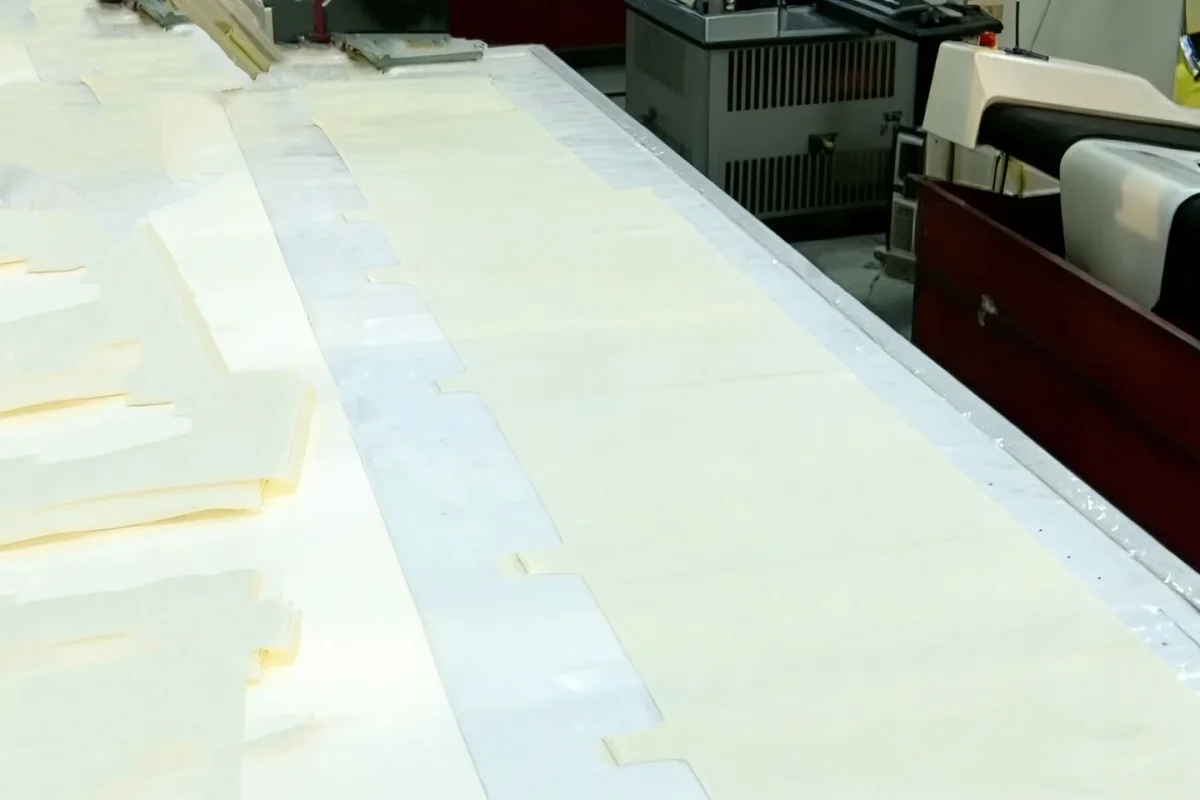
- For non-woven fabric, backlight or transmitted light is recommended to reveal penetrating holes
- Adjust transmitted light intensity for different gram weights to avoid over- or under-exposure
- Clean environments require low-emission equipment materials and regular cleaning
OK / NG Judgement
How results are judged and used
| Inspection Status | judgement | Interlocking Action |
|---|---|---|
| No holes, no foreign matter, complete assembly | OK | Release, Sample Retained for Traceability |
| Detect holes / stains / foreign matter | NG | Reject and Save Image |
| Missing Part / Assembly Anomaly | NG | Route to Review or Rework |
PLC and Automation Interlocking
How results connect to the production line
For medical consumables, piece-by-piece inspection with sample retention is recommended, binding defect images to the batch to meet medical traceability and sample retention requirements.
In a clean workshop, equipment dust emission and heat generation must be controlled, and the optics and machine body cleaned regularly to avoid contaminating the product.
Applicable equipment
Common configuration forms for this type of inspection
Related Solutions
View the corresponding solution by inspection task
Common Question
The Questions Most Often Asked in This Industry
Non-woven fabric has no regular texture - how are defects detected?
Non-woven fabric has a random fiber structure, so a period cannot be modeled as it can for a woven fabric; anomaly detection can only use local fiber statistics as a reference. The randomness itself causes false alarms, so it must be calibrated with real defective samples.
Can vision find small holes in protective clothing?
For penetrating holes, transmitted / backlight imaging is recommended to highlight them. Pinhole-level holes require sufficient resolution, to be supplemented. The lower detection limit must be measured according to the smallest hole size.
Can vision replace bacteria barrier and sterilization testing?
cannot. Vision judges appearance only (holes, stains, foreign matter, missing part), sterilization efficacy, bacterial barrier properties, and blood penetration are covered by biological and material testing, and the boundary of responsibility must be clearly defined.
What Is the Smallest Hole That Can Be Detected?
Determined by resolution and field of view; it must be back-calculated from the minimum detectable dimension and measured. TBD. For protective clothing, we recommend back-calculating from the most stringent protection level.
Can Standard Equipment Be Used in a Cleanroom?
Equipment materials, surface treatment, particle generation and lubrication need to be assessed. Some scenarios need a low-particle-generation configuration with regular cleaning; this is confirmed together with the environmental requirements during the solution stage.
How are retention samples and traceability handled for medical consumables?
Per-piece inspection results and images are bound to the batch number and retained, supporting batch queries and sample retention. The specific interface is determined by the customer's quality system.
Do non-woven fabrics of different gram weights need different parameters?
Yes. Grammage affects light transmission and image brightness, and transmitted intensity must be matched to grammage, otherwise hole contrast is insufficient. We recommend creating an imaging recipe for each grammage.
For visual inspection in this industry, what needs to be solved first?
The implementation constraints commonly seen in this industry center on: "non-woven fabric fibers are randomly distributed, there is no regular texture to model, and the interference comes from the randomness itself"; "holes in protective clothing are small and may be pinhole-level, requiring sufficient resolution"; "cleanrooms impose constraints on equipment materials, particle emission and lubrication". These constraints affect both the imaging solution and the cycle-time design. Normally a sample trial is needed to validate before the configuration is finalized.
How does the inspection result interlock with the production line?
For medical consumables, piece-by-piece inspection with retained samples is recommended, binding defect images to the batch to meet medical traceability and sample retention requirements. In a cleanroom, equipment particle emission and heat generation must be controlled, and optics and the machine body cleaned regularly to avoid contaminating the product.
What Equipment Configuration Does This Type of Inspection Generally Require?
Common forms include: "medical consumable inspection equipment", "personal protective equipment inspection equipment", "specialty apparel inspection equipment". The specific machine model and quantity depend on the inspection area, the minimum defect size and the line cycle time, and must be confirmed according to the site conditions.
Which process steps in this industry benefit most from a visual inspection station?
The most common are: "recognition of through holes in non-woven fabric / protective clothing"; "recognition of stains, foreign matter and fiber clumps"; "confirmation of missing parts and assembly for medical consumables." Which process steps to actually instrument depends on the cost of defects escaping downstream and the cost of rework — the later a defect is found, the higher the cost.
How do we judge whether our product is suitable for visual inspection?
Please provide medical non-woven fabric / protective clothing / consumable samples (including samples with holes, stains and missing parts) together with the cleanliness class and retained-sample traceability requirements. In general, as long as the criteria can be stated clearly, defects can image clearly and consistently, and the cycle time matches the field of view, the project is feasible.
What inspection accuracy can be achieved?
Accuracy is not a fixed value that holds regardless of conditions. To be added — the minimum detectable size depends on the combination of field of view and camera resolution, and is also affected by illumination, lens and algorithm; the configuration must be derived from your minimum defect size and validated by measurement.
Submit sample testing
Please provide medical non-woven fabric / protective clothing / consumable samples (including samples with holes, stains and missing parts) and the cleanliness level and retained sample traceability requirements.
Submitted successfully
We have received your sample testing request. A solution engineer will contact you within 1 business day via contact you.
Need to assess imaging conditions, defect criteria and cycle time item by item? Go to the Full Requirement Assessment →
Inspection Configuration Based on Your Industry's Products and Cycle Time
Send us photos of the workpiece, the inspection requirement (what to inspect, and the tolerance for escapes and false calls), and the line cycle time, and our solution engineers will recommend the inspection method, optical solution, and interlocking configuration for that industry.